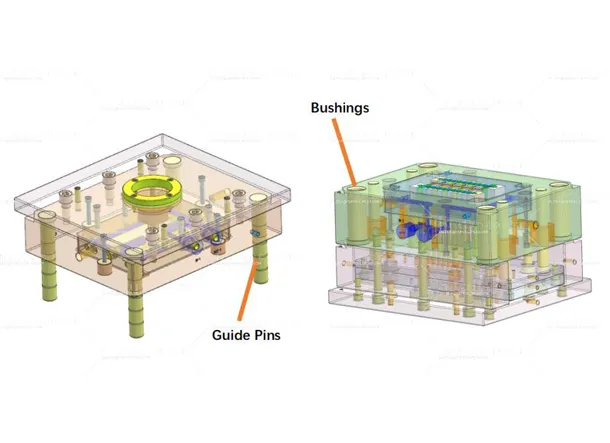
Limit stops—also called spacer pads, stop pins, or even “garbage pins” in shop‑floor slang—are small but essential components in injection molds. Their job is to support the ejection system, control the ejection stroke, and prevent damage when the ejector plate returns.
A standard limit stop is shown in Figure 1‑1.
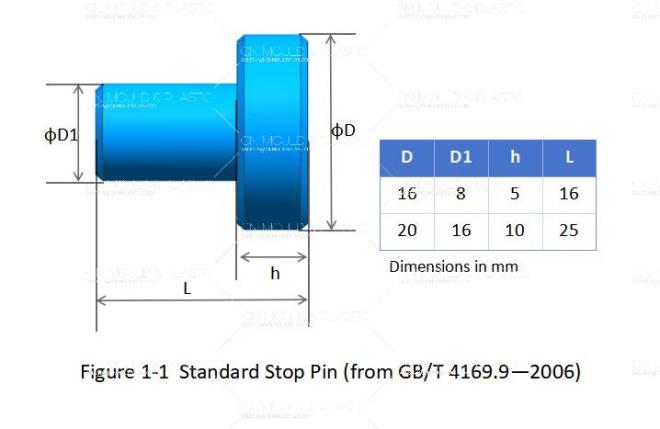
Limit Stop Pins Specifications
The following basic rules apply to limit stop design and machining:
Surface finish: Unspecified surfaces should be Ra 6.3 μm or better.
Undercut or radius: Provide either a wheel relief groove or a radius of 0.5–1.0 mm at the base to avoid stress concentration.
Positioning: Limit stops should be placed on the same axis as the return pins. Use enough stops to prevent the ejector plate from bending or flexing during ejection.
Mounting method: For small molds, the limit stops are fixed to the ejector plate. For large molds, they are fixed to the moving mold base plate.
Limit Block Requirements
In addition to round stop pins, some molds use stop blocks. These follow a separate set of rules:
Minimum height: Stop blocks must be at least 6.35 mm tall.
Quantity: Use at least two stop blocks per mold.
Ejection clearance: The blocks must allow the part to be ejected at least 5 mm beyond the moving mold surface.
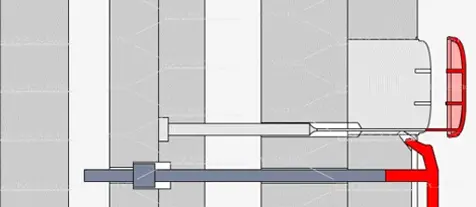
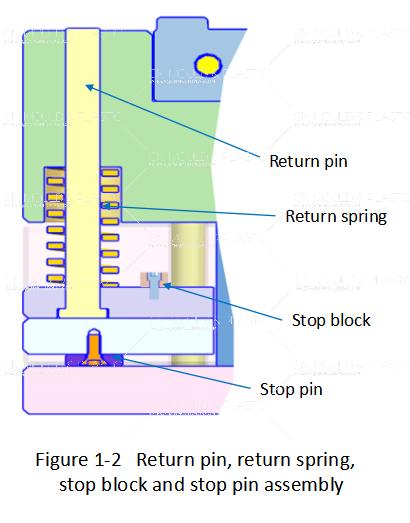
Mounting location: Stop blocks are typically mounted either on the bottom face of the moving mold base plate (see Figure 1-2) or on the top face of the ejector plate. They are secured with screws.

 English
  français
  Deutsch
  Español
  italiano
  русский
  português
  العربية
  dansk
dansk  Suomi
Suomi  Svenska
  norsk
norsk