Ribs are reinforcing structures used to enhance the strength and rigidity of injection-molded thermoplastic parts. They play a crucial role in enabling engineering thermoplastics to successfully replace metal components. A well-designed rib layout not only improves the load-bearing capacity of thermoplastic structures but also offers significant production advantages: lower costs, shorter cycle times, and the elimination of thick sections that often cause sink marks. Additionally, ribs help reduce hot spots in the mold, minimize warpage, and improve the dimensional accuracy of the final product.
However, designing ribs can be challenging—especially when product developers must rely on trial and error to determine optimal rib strength, geometry, size, and spacing.
A rational rib design process involves five key aspects: thickness, height, placement, quantity, and moldability. Each of these requires careful attention during the design phase.
Determining the right rib thickness is a multi-faceted decision. Excessively thick ribs can cause sink marks and surface defects on the opposite side of the attached wall (see Fig. 1-1), compromising both quality and appearance.
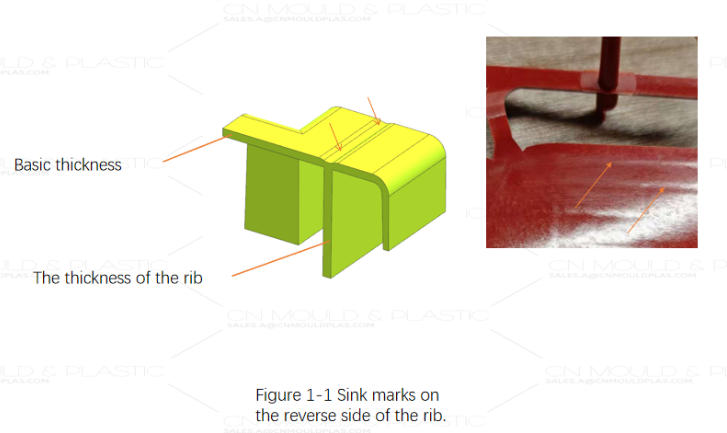
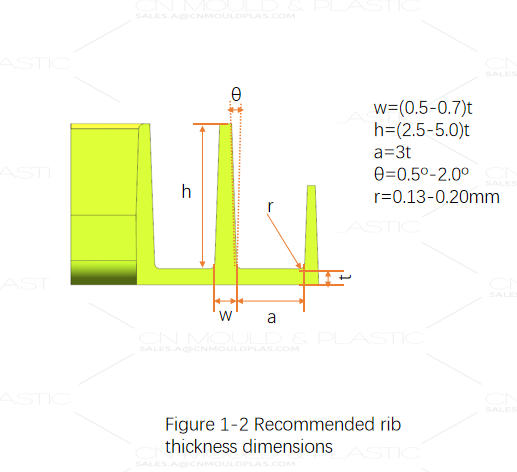
Fig. 1-2 illustrates recommended rib thickness dimensions based on wall thickness:
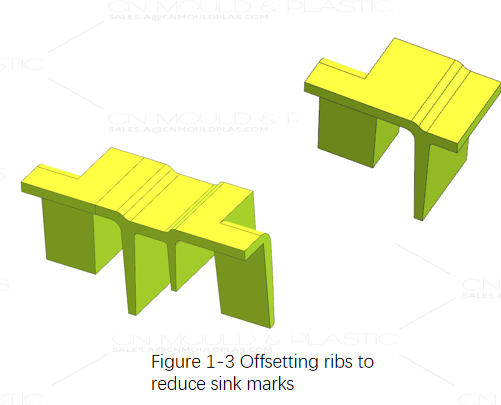
For critical high-gloss surfaces, thinner ribs may be necessary to avoid visible defects. To mask potential sink marks, ribs can be strategically placed opposite raised features such as logos or steps, as shown in Fig. 1-3:
Thin-walled parts can often accommodate ribs with a higher percentage thickness relative to the wall. In particular, when the nominal wall is 1.0 mm or less, it’s often advisable to use a rib thickness equal to the wall thickness to ensure both strength and moldability. On the other hand, excessively thin ribs may be difficult to fill completely due to limited melt flow, which can lead to incomplete filling or weak spots.

 English
  français
  Deutsch
  Español
  italiano
  русский
  português
  العربية
  dansk
dansk  Suomi
Suomi  Svenska
  norsk
norsk