The use of metal inserts in plastic injection molding enhances part functionality but introduces design challenges. Poor insert design can lead to defects like cracks, warpage, or failure. This post outlines six key principles to ensure robust and reliable insert integration.
Optimize Shape for Uniform Shrinkage
Inserts should ideally be circular or symmetrical. This shape promotes uniform plastic shrinkage around the insert during cooling, minimizing residual stress and warpage.
Ensure Adequate Wall Thickness
The different thermal expansion and shrinkage rates of metal and plastic create significant stress at their interface.
A thicker plastic wall around the insert acts as a buffer, reducing the risk of cracking.
A sufficient layer of plastic must also cover the top of the insert to prevent surface defects like sink marks or exposure.
Incorporate Chamfers on the Insert
The embedded edges of the insert should feature chamfers (angled cuts). This simple step is crucial for reducing stress concentration points in the surrounding plastic as it cools and contracts.
Provide Secure Positioning in the Mold
The insert must be firmly and precisely located within the mold cavity.
During injection, high-pressure melt flow can displace or deform a poorly secured insert.
Plastic can also seep into the insert's internal features (e.g., holes, threads), rendering them unusable.
Pro Tip: For small internal thread inserts (below M3) and lower injection pressures, inserting them onto a smooth pin in the mold can simplify the process. While minor plastic flash may enter the threads, it often does not hinder functionality and greatly eases assembly.
Limit Unsupported Length to Prevent Bending
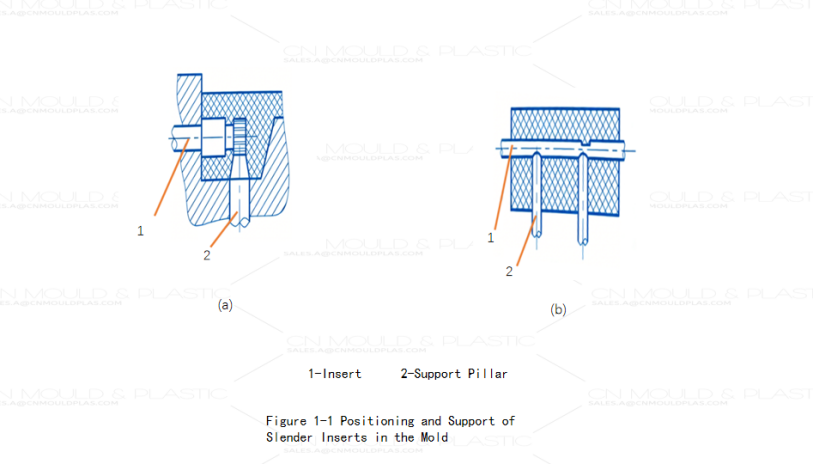
The free-standing length of an insert should generally not exceed twice its diameter. For longer projections, support pillars must be designed into the mold to prevent bending under injection pressure. Note that pillars will leave a corresponding hole in the final part, so this feature must be placed in a non-critical area. (See Figure 1-1 for an illustration of this support mechanism.)
Strategize Placement Near Walls or on Bosses
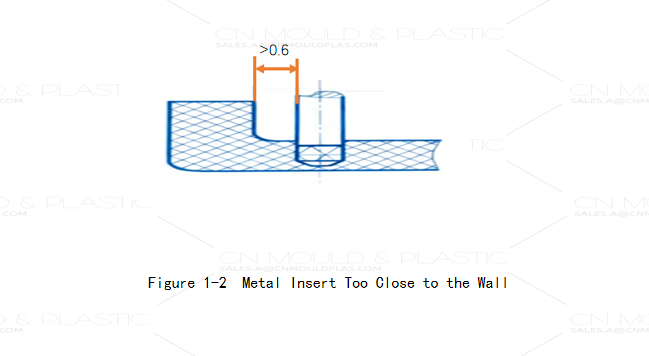
Placing an insert too close to a mold wall complicates machining the locating hole and can weaken the mold structure.(Refer to Figure 1-2)
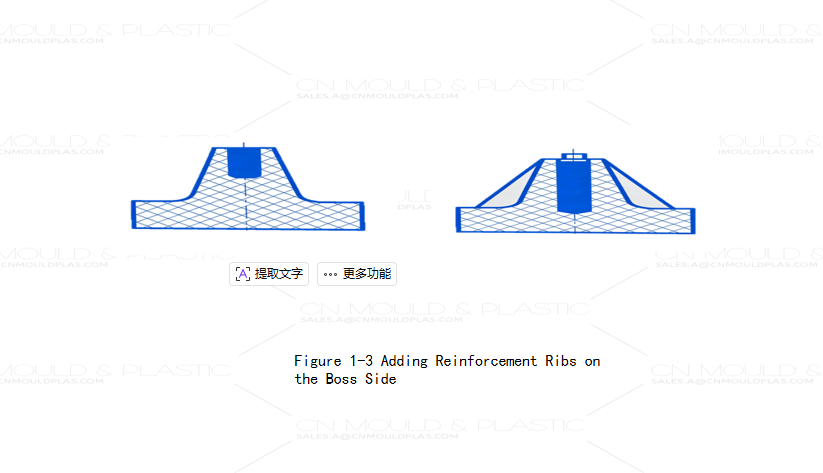
When an insert must be placed on a boss (a raised feature), adding reinforcement ribs to the side of the boss is highly recommended. This strengthens the local area and improves material flow. (Refer to Figure 1-3 for a visual example.)

 English
  français
  Deutsch
  Español
  italiano
  русский
  português
  العربية
  dansk
dansk  Suomi
Suomi  Svenska
  norsk
norsk