In the world of product design, especially when dealing with multi-material injection molding, the design of the shut-off surface—where hard plastic meets soft TPE (thermoplastic elastomer)—is critical. This interface must be carefully engineered to ensure durability, functionality, and aesthetic quality.
What is a Shut-Off Surface?
The shut-off surface refers to the bonding line or interface between hard plastic and soft TPE. This is not just a visual boundary; it’s a structural junction that affects both performance and longevity.
Common Pitfall: The “Feather Edge”
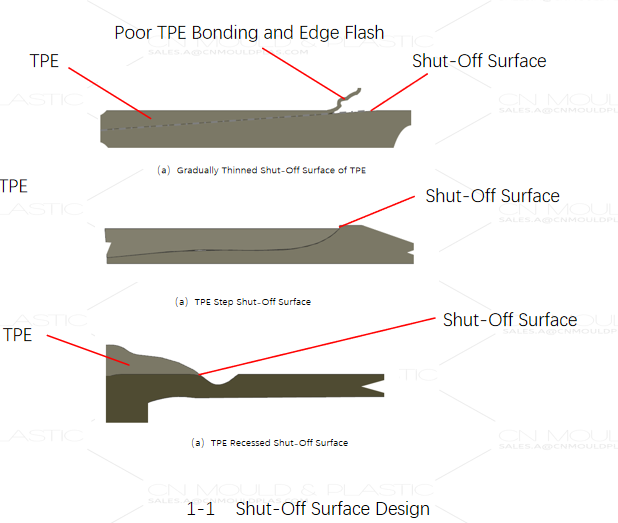
One of the most common mistakes in shut-off surface design is the creation of a feather edge—a gradually thinning wall thickness at the interface. As shown in Figure 1-1(a), this can lead to poor adhesion and edge lifting of the TPE. The uneven thickness causes weak bonding and increases the risk of delamination under stress or repeated use.
Ideal Design: Consistent Wall Thickness with a Step & Recess
To ensure a reliable bond, the shut-off surface should be designed with a clear step and recess, maintaining a consistent wall thickness of at least 1.0 mm for the TPE. This design approach, illustrated in Figures 1-1(b) and (c), provides structural stability and prevents peeling or failure at the interface.
Enhancing Durability with Mechanical Interlocking
In cases where the TPE flow length is exceptionally long, or the part is subject to frequent wear and tear, it’s advisable to incorporate mechanical interlocking features. These structures allow the TPE and hard plastic to penetrate each other, creating a stronger physical connection beyond just chemical adhesion. This is especially useful in high-stress or high-movement applications.

 English
  français
  Deutsch
  Español
  italiano
  русский
  português
  العربية
  dansk
dansk  Suomi
Suomi  Svenska
  norsk
norsk