The purpose of embedding inserts in plastic products is to enhance local strength, hardness, wear resistance, electrical conductivity, magnetic permeability, etc., to increase the dimensional and shape stability of the product, or to reduce plastic consumption. Materials for inserts include metal, glass, wood, and pre-formed plastics, with metal inserts being the most commonly used.
Forms of Metal Inserts
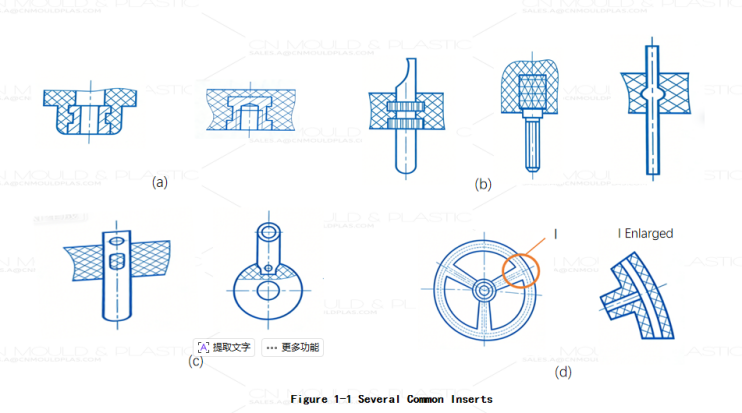
As shown in Figure 1-1, several common metal inserts are illustrated. Among them, Figure 1-1 (a) shows cylindrical inserts, which come in through-hole and blind-hole types, with threaded holes being the most common. These are primarily used for frequently disassembled applications, areas subjected to significant stress, or for threaded connections at conductive points. Figure 1-1 (b) depicts stepped cylindrical inserts, including plain shafts and threaded rods. Figure 1-1 (c) shows sheet inserts, often used as internal conductors or soldering tabs in plastic parts. Figure 1-1 (d) illustrates thin rod-type through inserts. For example, plastic automotive steering wheels incorporating such metal rod inserts exhibit significantly improved strength and stiffness.
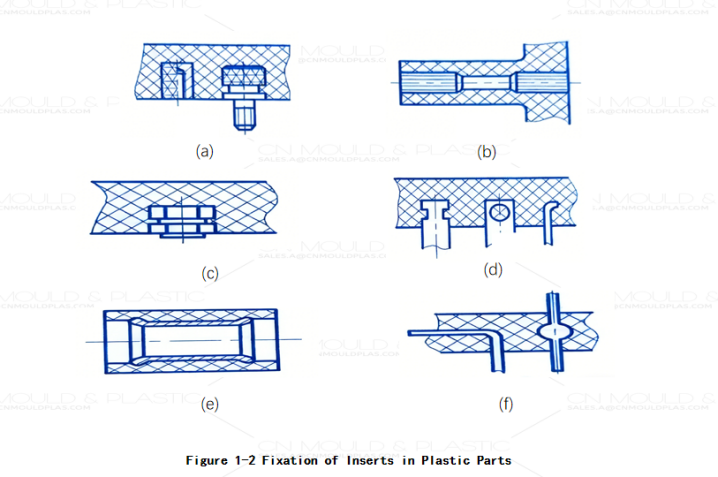
To ensure inserts are securely fixed within the plastic product and prevent them from rotating or pulling out under load, their surfaces must be designed with appropriate protrusions or recesses. Figure 1-2 shows common fixation methods for metal inserts within plastic products. Among these, Figure 1-2 (a) shows the most commonly used diamond knurling, which offers excellent resistance to both pull-out and torsion, providing the best fixation. Figure 1-2 (b) shows straight knurling. This type allows for slight axial elongation of the plastic part when the insert is long, reducing tensile stress in that direction. However, such inserts must have circumferential grooves to prevent being pulled out under force. Figure 1-2 (c) shows hexagonal inserts. Their use has declined as stress concentration is prone to occur at the sharp corners. Figure 1-2 (d) shows sheet inserts fixed using holes, notches, or local bending. Figure 1-2 (e) shows thin-walled tubular inserts fixed by flanging their edges. Figure 1-2 (f) shows pin-type inserts fixed by flattening or bending one section.

 English
  français
  Deutsch
  Español
  italiano
  русский
  português
  العربية
  dansk
dansk  Suomi
Suomi  Svenska
  norsk
norsk