When it comes to product structural design, wall thickness is far more than just a number—it’s a critical factor that influences cost, manufacturing efficiency, mechanical performance, and even aesthetics.
In this post, we’ll break down some practical principles for intelligent wall thickness design.
Design Based on Need
Wall thickness should be “distributed on demand.” Not every part of a product requires the same thickness. Strategic variation can save material, reduce weight, and improve functionality:
Decorative or non-structural elements (e.g., logos, trim strips) can use thinner walls (e.g., 0.8–1.2 mm) to minimize cost and weight.
Critical load-bearing areas (e.g., connectors, bushings) require calculated thickness. Often, a combination of thicker walls + ribs is ideal.
- Rib thickness is typically 0.5–0.7x the main wall thickness.
- Rib height is usually 3–5x the wall thickness.
This approach enhances strength without over-thickening the entire part.
Use the Minimum feasible Wall Thickness
Choosing the thinnest possible wall—while meeting functional requirements—is key to reducing cost and improving mold cycle times:
- Start with the minimum allowable thickness for your material and process (e.g., 1.0 mm for ABS injection molding).
- Increase only where needed (e.g., 2.0–2.5 mm for high-stress zones).
- If strength is a concern, add ribs or change the cross-section shape (e.g., from rectangular to U-shaped or circular) instead of uniformly increasing thickness.
But note: minimum doesn’t mean “as thin as possible.” Consider assembly, handling, and shipping—parts that are too thin may be prone to damage before they even reach the customer.
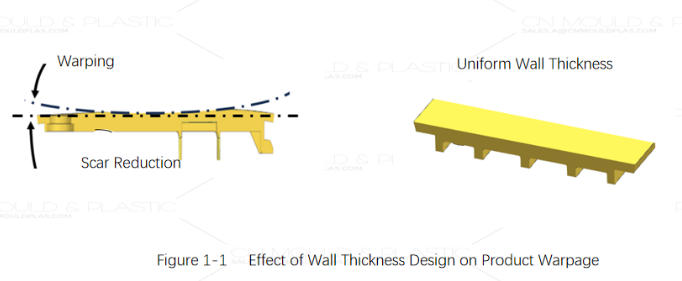
Avoid Warpage with Uniformity
Uneven wall thickness can lead to inconsistent cooling and shrinkage—a major cause of warpage. As shown in the figure below, variation in wall thickness often results in distorted finished products.
In a Nutshell
- Customize thickness based on function.
- Use ribs and smart geometry to reinforce thin sections.
- Keep walls as thin as possible—but not thinner.
- Aim for uniform thickness to prevent warping.
By applying these principles, you can design products that are not only stronger and lighter but also more efficient to manufacture.

 English
  français
  Deutsch
  Español
  italiano
  русский
  português
  العربية
  dansk
dansk  Suomi
Suomi  Svenska
  norsk
norsk