To avoid stress concentration, enhance the strength of plastic parts, improve melt flow, and facilitate demolding, transitional arcs should be applied at all junctions between inner and outer surfaces of a plastic part. Furthermore, fillets not only improve the aesthetic appeal of the part but also prevent the mold cavity from cracking due to stress concentration during quenching or in service.
The dimensions of a fillet, along with wall thickness, are related to the degree of stress concentration. Figure 1-1 illustrates the relationship between the inner fillet radius (R), wall thickness (δ), and the stress concentration factor. As shown, maintaining R/δ within the range of 0.25–0.75 is generally considered optimal.

In practical design, the fillet radius for a plastic part is often selected based on the relationship depicted in Figure 1-2, or more simply, the inner fillet radius is commonly rounded to 0.5–1 mm.

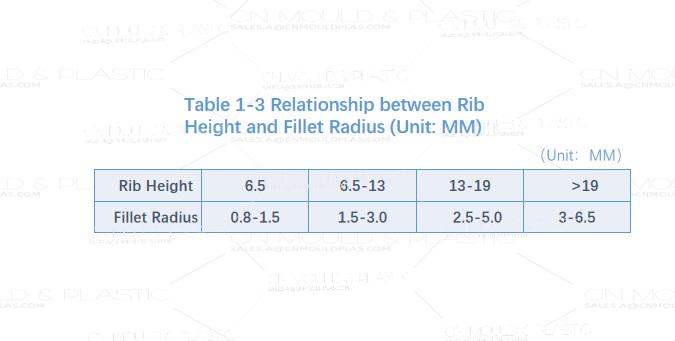
Fillets should also be designed at the tops and roots of reinforcing ribs, among other locations. The relationship between rib height and fillet radius is presented in Table 1-3.

 English
  français
  Deutsch
  Español
  italiano
  русский
  português
  العربية
  dansk
dansk  Suomi
Suomi  Svenska
  norsk
norsk