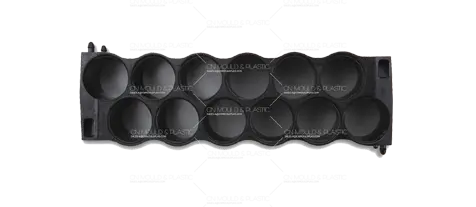
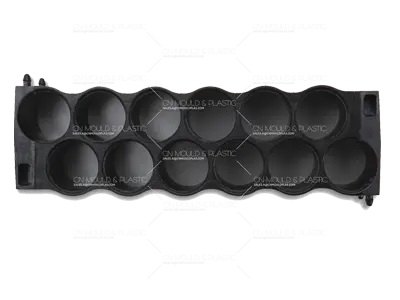
In injection molding, blind holes (non-through holes) are formed by core pins that are supported only from one side of the mold, as illustrated in Figure 4-40. While this is a common design feature, it presents unique challenges during the molding process. The flowing molten plastic exerts significant lateral forces on the core pin, especially when forming deep or long holes. These forces can deflect or bend the core, altering the final shape of the molded part. In severe cases, repeated stress may even fatigue the mold steel and cause core damage.
To ensure part quality and mold longevity, designers must adhere to certain guidelines regarding the depth of blind holes relative to their diameter.
General Depth-to-Diameter Ratio
As a rule of thumb, the depth of a blind hole should not exceed three times its diameter. For holes with a diameter smaller than 5 mm, this ratio should be reduced to 2:1 to maintain adequate core strength and rigidity.
Special Cases for Deeper Holes
In some situations, a higher depth-to-diameter ratio may be acceptable. If the core is positioned in an area where melt flow is symmetrical around it—balancing lateral forces—or if the core is located in a region of slow flow, the ratio can be extended up to 5:1. However, this requires careful analysis of the filling pattern and flow simulation.
Avoiding Long, Vulnerable Cores
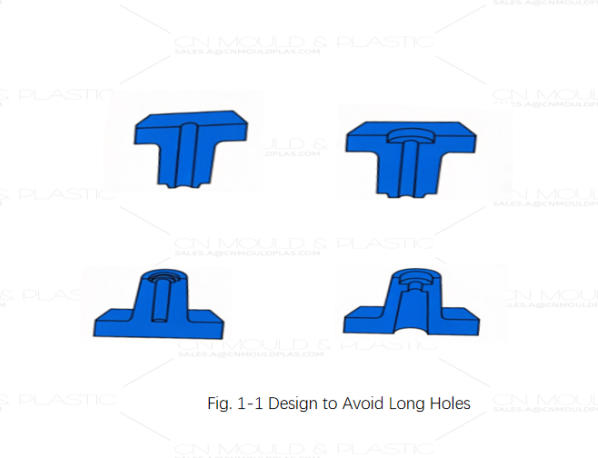
Wherever possible, part designs should avoid long, slender cores. One effective strategy is to split a long hole into two separate features, as shown in Figure 1-1. This reduces the unsupported length of the core and minimizes the risk of deflection.
Bottom Thickness Requirement
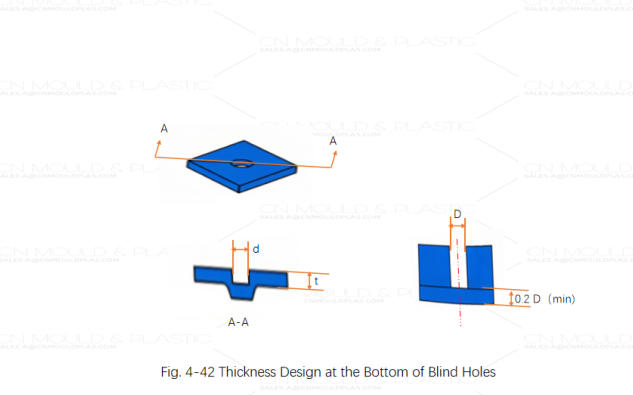
Another critical consideration is the thickness of material at the bottom of the blind hole. To prevent surface defects (such as sink marks or read-through) on the opposite side of the part, the remaining wall thickness should be at least 20% greater than the hole’s diameter. This ensures sufficient material to withstand molding pressures and maintain a smooth appearance.(as shown in Figure 1-2)
By following these design principles, engineers can produce high-quality parts with reliable, long-lasting molds. Always validate your design with mold flow analysis and consult with tooling experts for complex geometries.

 English
  français
  Deutsch
  Español
  italiano
  русский
  português
  العربية
  dansk
dansk  Suomi
Suomi  Svenska
  norsk
norsk