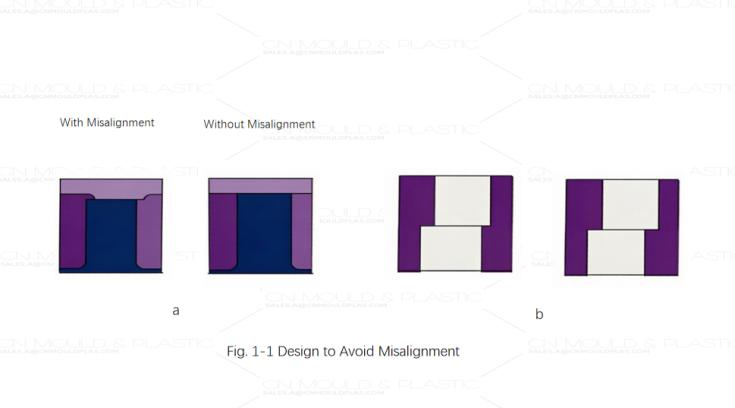
Misalignment during molding can significantly reduce the effective opening size of holes formed by mating core pins. This issue directly impacts part fit, function, and overall quality, so it’s critical to address it early in the design phase. Here are practical strategies to mitigate misalignment in plastic part hole design:
1. Single-Side Molding for Holes
Where design constraints allow, consolidate hole formation onto a single mold half (see Figure 1-1a). By eliminating the need for two mating core pins to align perfectly, you remove the primary source of misalignment-related shrinkage in hole openings. This approach simplifies mold construction and ensures consistent hole diameter across production runs.
2. Oversized Core Pin for Tolerance Buffer
When single-side molding isn’t feasible, use a slightly oversized core pin (see Figure 1-1b). This intentional oversize acts as a buffer: even if minor misalignment occurs between the two mold halves, the final hole will still meet the required diameter specification. This is a cost-effective workaround for non-critical holes where slight dimensional variation is acceptable.
3. Interlocking Features for Tight Tolerance Holes
For holes with tight, non-negotiable tolerances that can’t be graded, add interlocking features to the core pins. These mechanical features (e.g., complementary notches or tabs) correct minor misalignment during mold closing, ensuring precise alignment of the core pins. However, this solution increases mold manufacturing complexity and maintenance costs, so it should be reserved for high-precision applications.
4. Edge Rounding for Short Through-Holes
For short through-holes that can be formed with a single core pin, round one edge of the hole during design. This eliminates the need for a second mating core pin entirely, removing the risk of misalignment altogether. This streamlined approach is ideal for simple, short holes where edge rounding doesn’t compromise part function or aesthetics.
Key Takeaways
Misalignment in hole molding is a common challenge, but it can be managed with intentional design choices:
Prioritize single-side molding to eliminate mating core alignment issues.
Use oversized core pins as a cost-effective buffer for non-critical holes.
Reserve interlocking features for high-tolerance holes, despite higher mold costs.
Simplify short through-holes with edge rounding to remove misalignment risks entirely.
By integrating these strategies into your plastic part design, you can ensure consistent, high-quality hole dimensions while balancing mold complexity and production costs.

 English
  français
  Deutsch
  Español
  italiano
  русский
  português
  العربية
  dansk
dansk  Suomi
Suomi  Svenska
  norsk
norsk