Cracks are a common yet critical defect in plastic injection molded parts. They not only compromise the product's aesthetics but, more importantly, its structural integrity and longevity. This post analyzes the primary causes of cracks and provides practical troubleshooting methods.
(1) Excessive Residual Stress
Residual stress is the leading cause of cracks. When the internal residual stress within a plastic part exceeds the resin's elastic limit, surface cracks or even fractures occur. The gate area is particularly susceptible because it typically experiences higher molding pressure than other regions, especially with sprue-type direct gates.
Furthermore, inconsistent wall thickness or uneven cooling rates can lead to differential shrinkage between thick and thin sections. This creates mutual tensile forces, resulting in residual stress.
Since residual stress is the main culprit, preventing cracks hinges on minimizing it. Key strategies involve optimizing the gating system and fine-tuning molding conditions.
Gating System Design:
Consider replacing a high-pressure direct gate with multiple pin-point gates or edge gates to distribute pressure.
Reduce the gate diameter.
For edge gates, a tab gate can be used, with the gate location designed on a section to be removed post-molding.
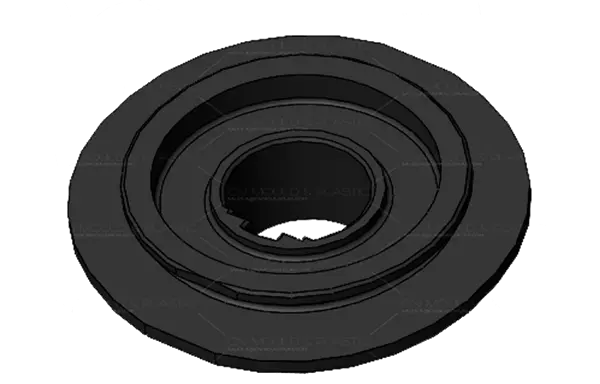
Implementing proper annular ribs around the gate can also help reduce cracking in that area.
Molding Conditions Adjustment:
Reduce Injection Pressure: The most straightforward method, as residual stress often increases proportionally with injection pressure. If cracks appear with darkened surroundings, it often indicates excessive injection pressure or insufficient material. Adjust by lowering pressure or increasing shot volume.
Optimize Cooling: For processes with low melt temperature, low mold temperature, and high injection pressure, consider appropriately lowering the mold temperature to reduce the melt-mold temperature differential. Control the cooling time and rate within the cavity to allow polymer chains adequate time for relaxation.
Shorten Holding Time: While ensuring the part is packed sufficiently to avoid sink marks, reduce the holding time. Excessively long holding times can contribute significantly to residual stress buildup.
(2) Stress Concentration Due to External Forces
External forces during ejection can concentrate stress, leading to cracks, often visible around ejector pins.
Solutions:
Inspect and Adjust the Ejection System: Ensure ejector pins are positioned at areas with the highest demolding resistance, such as bosses or ribs.
Adequate Draft Angles: Insufficient draft angles on mold cores and cavities increase friction and stress during ejection. Ensure all vertical faces have sufficient draft.
Proper Ejector Design: Poorly designed ejector pins (e.g., sharp edges, small contact area) can create high local stress. Use appropriately sized pins with well-radiused tips.
(3) Poor Part Design
Part geometry itself can induce stress concentrations, making cracks more likely.
Design Guidelines:
Avoid Sharp Corners and Notches: These are prime locations for stress concentration.
Implement Gradual Transitions: Use generous fillets and radii at corners and changes in wall thickness. A good rule of thumb is to maintain a transition radius-to-wall thickness ratio of approximately 1:1.7. For example, a fillet radius should be about 0.6 times the adjacent wall thickness. This not only reduces stress concentration in the part but also prolongs mold life by reducing stress in the tool steel.

 English
  français
  Deutsch
  Español
  italiano
  русский
  português
  العربية
  dansk
dansk  Suomi
Suomi  Svenska
  norsk
norsk