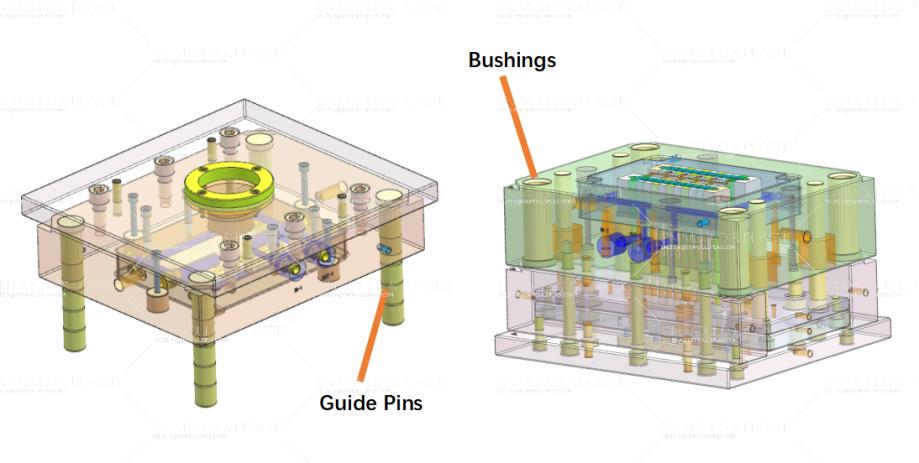
In injection mold design, guide pins and guide bushings ensure proper alignment between the moving and fixed halves of the mold. Poorly designed guiding components can lead to mold damage, inconsistent part quality, and a shorter tool life. Below are the key design requirements for both guide pins and bushings.
1. Design Requirements for Guide Pins
Length
The effective length of the guide pin should be 6–8 mm longer than the protruding length of the core. This ensures that the guide pin enters the bushing before the core reaches the cavity, preventing accidental collision and damage.
Shape
The front end of the guide pin should be tapered or hemispherical, with a taper angle of 20 to 30 degrees. This lead‑in shape helps the pin enter the bushing smoothly.
Material
Guide pins need a hard, wear‑resistant surface and a tough, fracture‑resistant core. Common material choices include T8A steel hardened to 52–56 HRC, or 20 steel with carburizing and quenching — the case depth should be 0.5–0.8 mm, with a hardness of 56–60 HRC.
Fit Tolerances
The fit between the guide pin and the mounting hole in the mold plate is typically H7/k6. The sliding fit between the guide pin and the guide bushing is typically H7/f7.
Surface Roughness
The fixed mounting portion should have a surface roughness of Ra 0.8 μm or better. The sliding portion requires a smoother finish of Ra 0.4 μm. Non‑contact surfaces are acceptable at Ra 3.2 μm.
Anti‑Misassembly Design
To prevent assembling the moving and fixed mold halves incorrectly, you can use an asymmetric arrangement of equal‑diameter pins, a symmetric arrangement of unequal diameters, or symmetric equal‑diameter pins with external markings on the mold plate.
Layout and Spacing
Place guide pins as far apart as possible to improve alignment accuracy. Also, maintain enough distance from the edge of the mold plate to ensure adequate strength around the mounting holes.
Placement Location
Guide pins can be installed on either the moving or fixed mold half. If the fixed half has a parting surface, it should be equipped with guide pins. For molds that use a stripper plate for ejection, the side with the stripper plate should have guide pins.
2. Design Requirements for Guide Bushings
Because guide holes wear out over time and are difficult to repair once worn, guide bushings are used. Bushings allow easy replacement or repair — this is especially important for high‑precision molds and high‑volume production.
Shape
The front inner edge of the guide bushing should have a rounded radius (R) to help the guide pin enter smoothly.
Material
The same materials as guide pins — typically T8A or 20 steel with appropriate heat treatment.
Fit Tolerances
For a straight bushing, the fit with the mold plate mounting hole is typically H7/n6. For a headed (flanged) bushing, the fit is typically H7/k6.
Surface Roughness
Both the fixed mounting portion and the sliding portion should have a surface roughness of Ra 0.8 μm or better. Non‑contact surfaces are acceptable at Ra 3.2 μm.

 English
  français
  Deutsch
  Español
  italiano
  русский
  português
  العربية
  dansk
dansk  Suomi
Suomi  Svenska
  norsk
norsk