Why Are Fillets (rounded corners) Important?
Most plastic parts have multiple intersecting surfaces. Unless otherwise specified, these intersections are typically designed with fillets rather than sharp corners. The benefits of fillets include the following:
1. Avoiding Stress Concentration
Sharp corners are prone to stress concentration, which can lead to cracking when the part is subjected to mechanical forces, impacts, or vibrations. This is especially critical during demolding, where the combination of residual molding stress and corner stress can easily cause the part to crack. Fillets effectively eliminate such stress concentration.
2. Improving Melt Flow
At sharp corners, molten plastic experiences flow resistance and turbulence, making cavity filling difficult. Fillets increase the flow path cross‑section, improving melt fluidity, promoting more uniform and stable cavity filling.
3. Extending Mold Life
Fillets on the mold — corresponding to those on the part — make the mold easier to machine and less likely to develop cracks during heat treatment.
4. Facilitating Demolding
Parts with sharp corners tend to adhere more tightly to the cavity, creating higher demolding resistance. Fillets reduce the friction coefficient between the part and the mold surface, making ejection easier.
5. Enhancing Aesthetic Appearance
Fillets give the part a more pleasing appearance and add commercial value. They also prevent the chipping and wear that sharp corners often suffer.
6. Increasing Part Strength
By reducing flow marks and uneven filling during melt injection, fillets contribute to a more uniform and stronger part structure.
Design Requirements for Fillets
1. General rule for corner radii
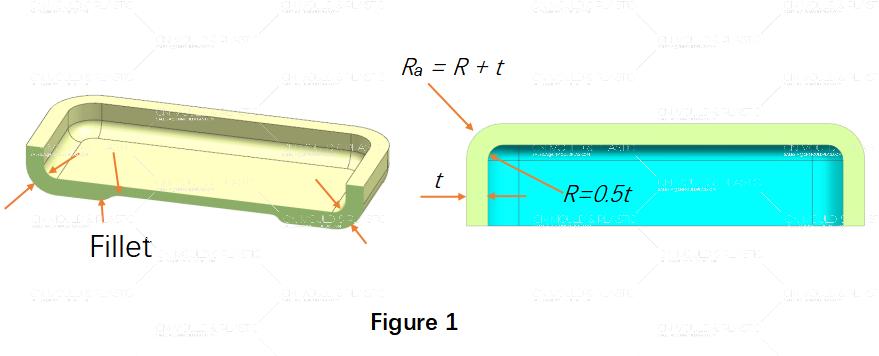
Unless special product requirements dictate otherwise, the transition radius is determined by the adjacent wall thickness. As shown in Figure 1, the inner corner radius should typically be 0.5 to 1.5 times the wall thickness (t). The minimum inner radius must not be less than 0.30 mm.
2. Maintaining uniform wall thickness at corners
As shown in Figure 1, when rounding both the external and internal corners, the wall thickness should remain consistent throughout: Rₐ = R + t
(where Rₐ is the outer radius, R is the inner radius, and t is the wall thickness)
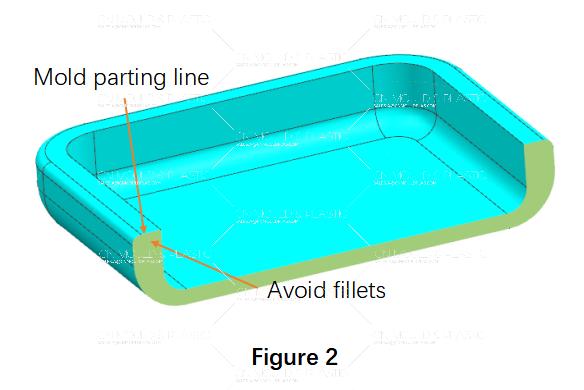
3. Avoid Fillets at the parting line and core/cavity mating surfaces
As shown in Figure 2, fillets in these areas can cause flash, leading to burrs on the part or even jamming of the core, which hinders demolding.
4. Minimum inner radius for effective stress reduction
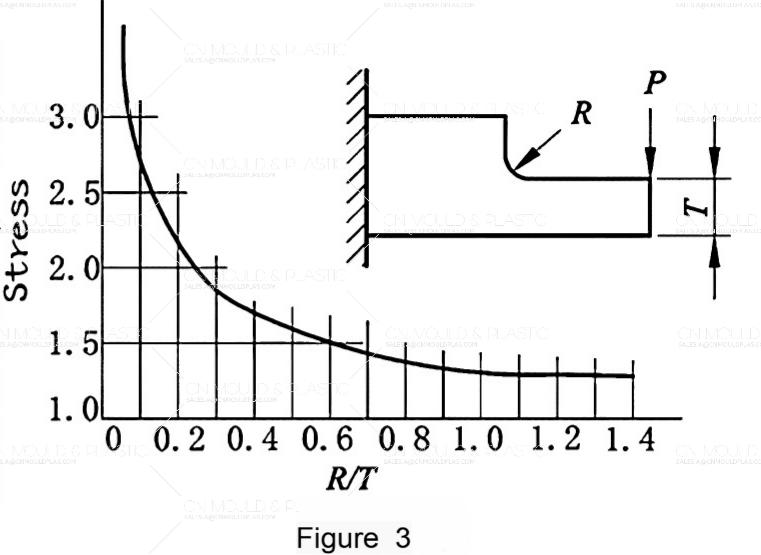
To achieve the full benefits of rounding, the inner radius R should be greater than one‑quarter of the wall thickness (t/4), as shown in Figure 3. An excessively small radius will not effectively reduce stress concentration.

 English
  français
  Deutsch
  Español
  italiano
  русский
  português
  العربية
  dansk
dansk  Suomi
Suomi  Svenska
  norsk
norsk