Why This Matters: Poor gas channel design leads to incomplete filling, gas blow‑through, and part defects. This guide shows you exactly where to place gas inlets and how to design gas channels for reliable, high‑quality results.
Gas Inlet Position
There are three common ways to position the gas inlet, depending on the part geometry and mold design.
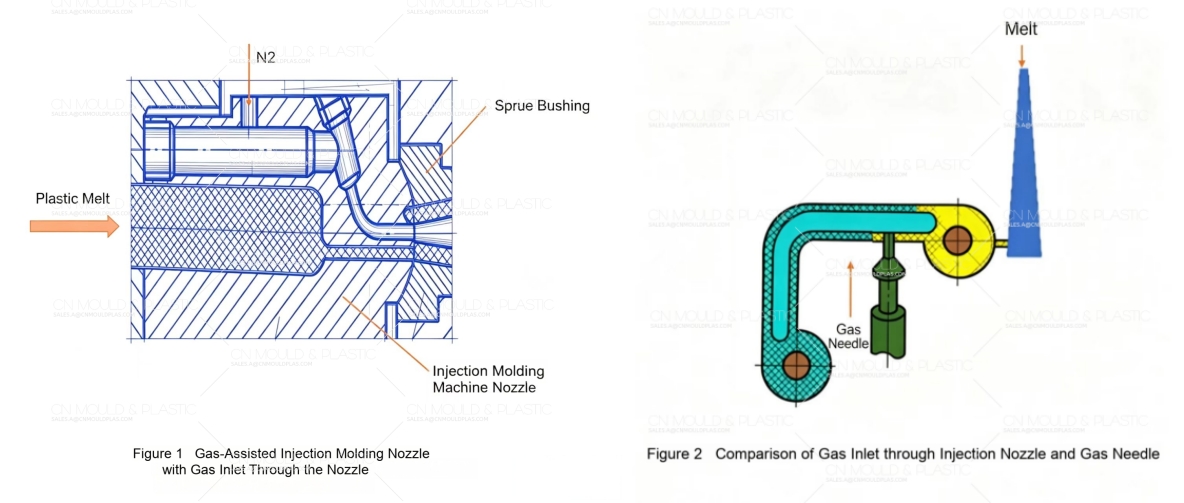
Through the nozzle: Gas enters at the same location as the melt gate, as illustrated in Figure 1.
Directly into the part: Place both melt and gas inlets in thick wall sections — never at the end of flow. Position the gas pin as far as possible from the last filling point to ensure even cavity filling.
Through the runner: Use one gas pin, keeping it at least 20 mm from the gate. Multiple gas pins may also be used, as illustrated in Figure 2.
Gas Channel Design
Proper gas channel design is essential for controlled gas penetration and part quality. Follow these 13 guidelines.
1. Gas channels should be arranged symmetrically or in a single direction relative to the gate.
2. Channels must be continuous and balanced across the cavity — never form a closed loop.
3. The total volume of gas channels should generally be less than 10% of the total part volume.
4. Ribs can be designed much thicker than the nominal wall to serve as gas channels.
5. Channel layout should follow the main melt flow direction. Gas must have a clear flow path. Use generous radii at corners.
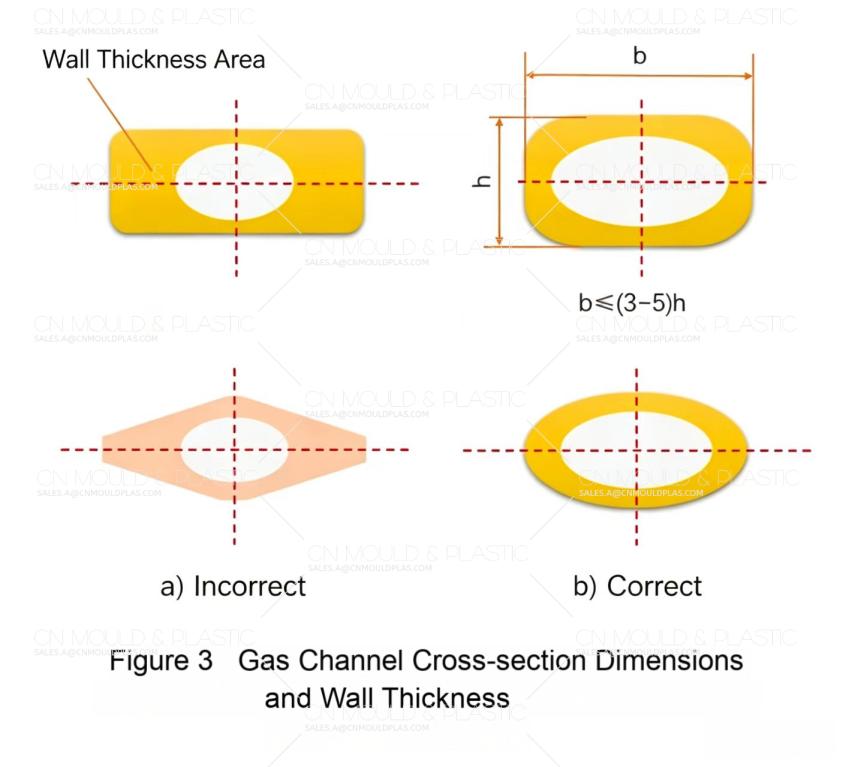
6. Channel size is critical: typically 2–4 times the wall thickness. Too large → weld lines and gas sinks. Too small → loss of gas control. Cross‑section should be round or near‑round (height/width ≈ 1) to avoid uneven plastic thickness around the channel, as illustrated in Figure 3.
7. For cylindrical parts, use a near‑circular cross‑section. Add large radii at any corners.
8. Always align channels with the primary melt flow direction.
9. Use large radii at channel corners.
10. Gas must penetrate all the way to the end of the channel.
11. If channels are too close, gas may penetrate into thin walls.
12. Gas should remain confined within the designed channels.
13. Gas follows the shortest path (minimum resistance) — design accordingly.

 English
  français
  Deutsch
  Español
  italiano
  русский
  português
  العربية
  dansk
dansk  Suomi
Suomi  Svenska
  norsk
norsk