In conventional manufacturing, many plastic parts require post‑molding assembly with other components — such as metal base plates or other plastic parts. This not only demands a lot of manual labor but also often leads to inconsistent assembly quality.
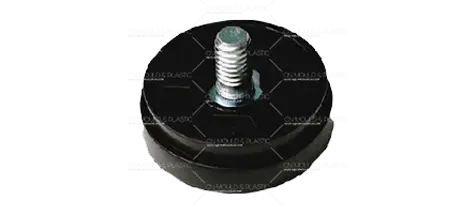
To solve these problems, engineers developed assembly injection molding. In this process, a metal base plate (or other component) is placed directly into the mold as an insert. The entire assembly — plastic parts and all — is then molded in a single shot.
This approach is especially well‑suited for plastic parts that are complex, delicate, or very small — the kinds of parts that are normally difficult and time‑consuming to assemble by hand.
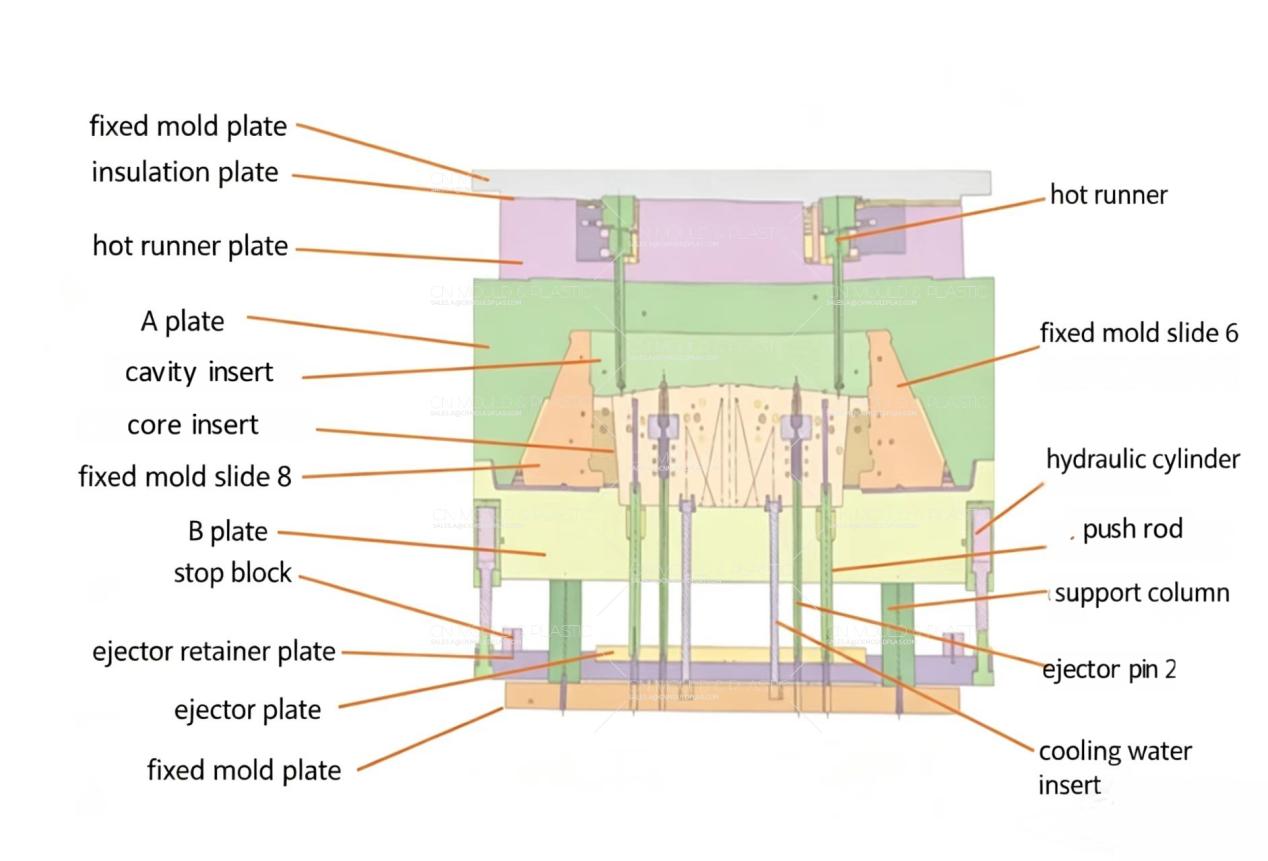
Below are key design guidelines for successful insert molding.
1. Design Considerations for the Plastic Part
Bonding performance: Evaluate how well the plastic bonds to the metal plate, especially after surface treatment.
Dimensional accuracy of the metal plate: In a cavity‑type structure, the cavity dimensions are closely related to the outer dimensions of the metal plate.
Fine details on the metal plate: Check whether chamfers, corner radii, and tapers might interfere with placing the plate into the mold.
Filling gaps around holes and slots: The pressure of the molten plastic will cause slight deviations. Ensure that concentricity and perpendicularity requirements are still met; otherwise, a high‑precision mold with a more complex design will be needed.
Secure bonding methods: Use grooves, knurling, or steps on the metal part to improve the strength of the bond between the metal and the plastic.
2. Cavity Material and Wear Resistance
The cavity material and its heat treatment should be selected based on wear caused by inserting and clamping the metal plate. It is common to design the plate‑holding area as a replaceable insert.
3. Asymmetric Exposed Areas of the Metal Plate
If the exposed areas of the metal plate are symmetrical, there is little pressure imbalance. If they are asymmetrical, higher molding pressure will be required. Generally, the hole in the mold that receives the metal plate should be 0.01–0.03 mm larger than the plate itself.
4. Determining Shrinkage
Conduct trials to determine the actual shrinkage rate of the material. This is essential for achieving high‑precision parts.
5. Ease of Loading the Metal Plate
To make it easier to place the metal plate, avoid protruding mold features on the lower mold half. Pins for aligning the plate should be installed on the upper mold half instead.
6. Removing Metal Dust
Metal powder from wear will accumulate at the bottom of the plate‑receiving cavity. The mold should include a path for removing this dust, and the area should be easy to disassemble for cleaning.
7. Error Detection
The mold should be equipped with a system to detect if the metal plate is loaded incorrectly. This prevents costly mold damage.
8. Part Ejection
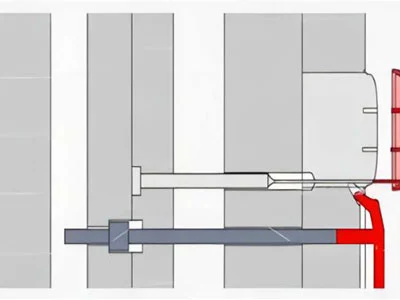
Design the mold so that the finished part stays on the lower mold half after molding. If this is not possible, an ejection mechanism must also be provided on the upper mold half.
9. Filling and Mold Features
The way the melt fills around the metal plate will be influenced by the parting line, gate location, and ejection layout. Therefore, try to maximize the precision of those dimensions that are determined directly by the mold cavity.
10. Parting Line Design for Filling Slots
The slot used to fill the area around the metal plate should be located on the lower mold half, while a compression rib is placed on the upper mold half. This improves handling of the metal plate and extends mold life.

 English
  français
  Deutsch
  Español
  italiano
  русский
  português
  العربية
  dansk
dansk  Suomi
Suomi  Svenska
  norsk
norsk