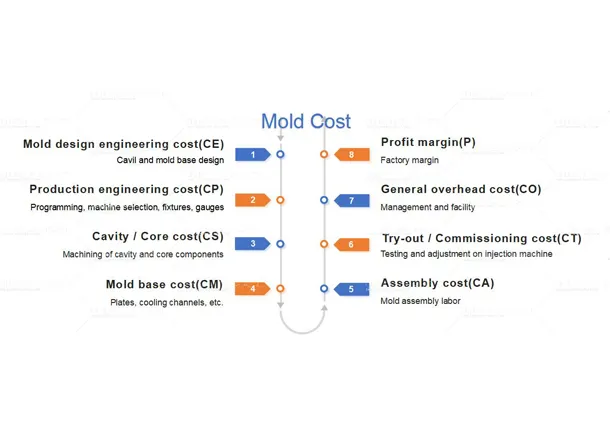
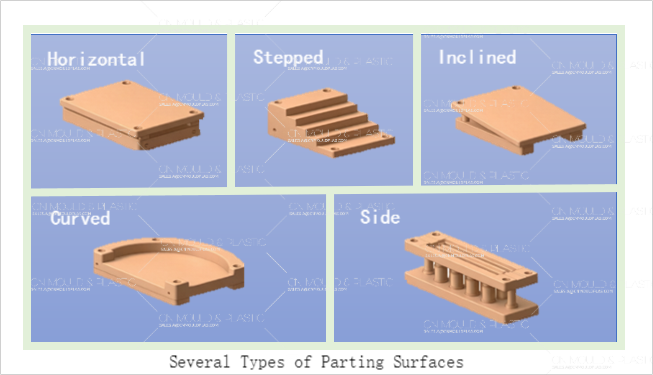
The parting line is the surface where the two halves of an injection mold meet. It can take many forms, including horizontal, stepped, inclined, curved, side, and even irregular shapes. While parting lines are typically flat, curved or stepped designs are sometimes necessary to make demolding easier. Although such parting lines are more complex to machine, they often simplify cavity manufacturing.
The location of the parting line directly affects the mold structure, gate position, and part precision. The following principles should be considered during design:
Ensure Easy Demolding of the Part
After molding, the part must remain on the moving half of the mold to facilitate the design of the ejection system. Generally, the main core is placed on the moving side, taking advantage of the part’s shrinkage to grip the core. The cavity can then be placed on the fixed side.
Keep the Mold Structure as Simple as Possible
The parting line should avoid introducing unnecessary complexity such as sliders or angled lifters. The simpler the structure, the lower the manufacturing and maintenance costs of the mold.
Facilitate Venting
Gases inside the mold are primarily expelled through venting slots along the parting line. Therefore, the parting line should be located at the end of the melt flow path. Placing it too close to the gate may cause poor venting.
Ensure Dimensional Accuracy and Precision
For example, to maintain the concentricity between a gear’s tooth profile and its center hole, both the gear core and cavity should be placed on the same side of the mold (e.g., the moving half). If placed on opposite sides, the alignment error of the guiding mechanism may compromise concentricity.
Maintain Good Surface Quality of the Part
If there is a gap at the parting line between the moving and fixed halves, the melt can form flash on the part, degrading its appearance. Therefore, avoid placing the parting line on smooth, flat surfaces or curved arc surfaces where appearance is critical.
Avoid Long-Distance Side Core Pulling
In conventional injection molds, side core pulling is achieved using the opening motion of the mold. The available pulling distance is limited by the mold’s opening stroke. For parts with holes or undercuts in two perpendicular directions, long-distance side core pulling should be avoided.
For complex products, the choice of parting line is often a trade-off among many factors. Designers should focus on the most critical requirements and continue building experience through practical application.

 English
  français
  Deutsch
  Español
  italiano
  русский
  português
  العربية
  dansk
dansk  Suomi
Suomi  Svenska
  norsk
norsk