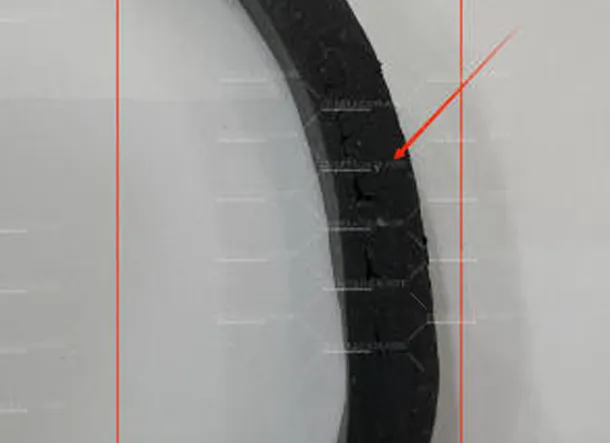
Venting is a critical aspect of injection mold design. Poor venting can trap gas inside the cavity, obstructing melt flow and causing plastic to burn due to compression-induced high temperatures. Under conditions of high speed, high temperature, low viscosity, high pressure, and thick wall sections, gas can easily penetrate the plastic part, leading to defects such as voids and porosity. Venting requirements are especially stringent in high-speed injection molding.
Common Venting Methods
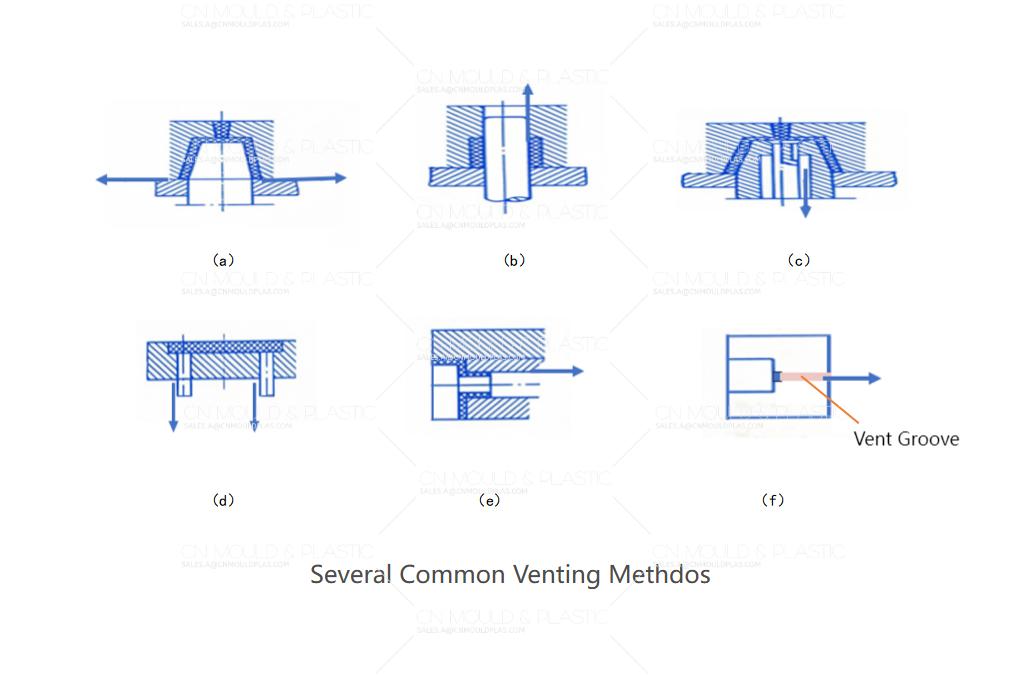
(a) Venting through the gap at the parting line
(b), (c), (d), (e) Venting through the clearances between moving components
(f) Venting via dedicated venting grooves on the parting line
Venting Groove Design
Venting grooves are typically sized between 1.5~6 mm in width and 0.02~0.05 mm in depth. The depth should be kept below the material’s flash threshold to prevent plastic from leaking out.
Key Considerations
1. Determining Adequate Venting
As a general rule, venting is sufficient if no burn marks appear on the part at the maximum injection rate. For conventional molding, natural venting through parting lines or component clearances often suffices. However, high-speed, precision, or thermoset molding usually requires specially designed venting grooves.
2. Placement of Vents
The parting line is the preferred location for vents, as it allows flash to be easily ejected with the part. Vents should generally be placed at the end of the melt flow path, near inserts, or at the thinnest wall sections. Vent placement should also be coordinated with gate design—proper gating can help improve weld lines and surface quality. For complex parts, trial molding or CAE mold flow analysis can help determine optimal vent locations.
3. Preventing Vent Blockage
When using clearances around inserts or cores for venting, these gaps can easily become clogged with flash, making the venting unreliable. In such cases, dedicated venting grooves should be added, or regular cleaning should be performed. Additionally, care must be taken to prevent flash caused by excessive clearances, which can interfere with part ejection.

 English
  français
  Deutsch
  Español
  italiano
  русский
  português
  العربية
  dansk
dansk  Suomi
Suomi  Svenska
  norsk
norsk