In the realm of waterproof product manufacturing, the precision of mould design and the selection of mould materials are pivotal to ensuring product performance, durability and waterproof integrity. This blog delves into the core structural and material heat treatment specifications of a two-color mould developed for waterproof component production, with the first color adopting PP+30%GF compound and the second color using TPE compound, laying a solid foundation for the high-quality production of waterproof parts.
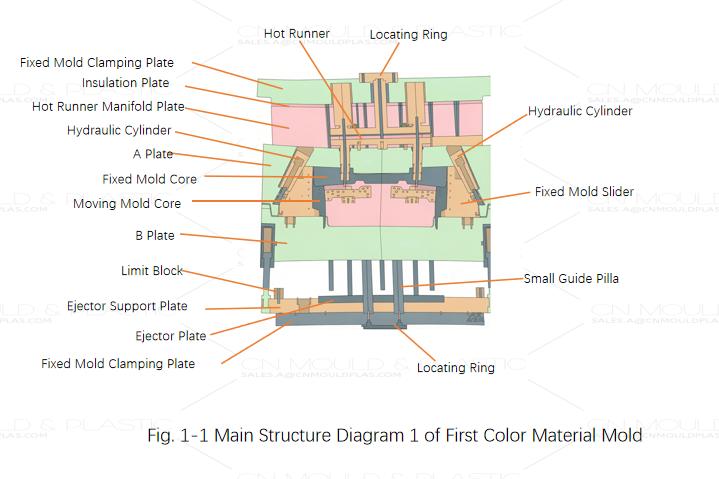
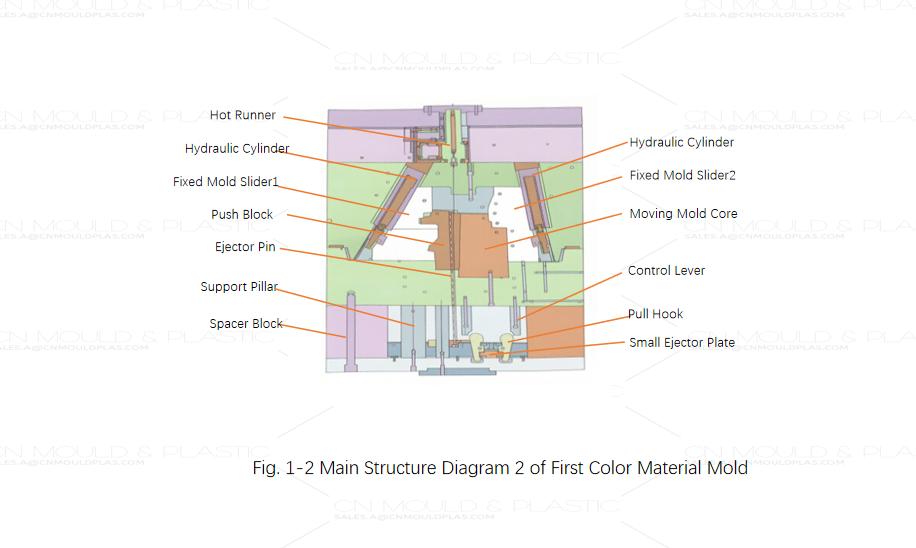
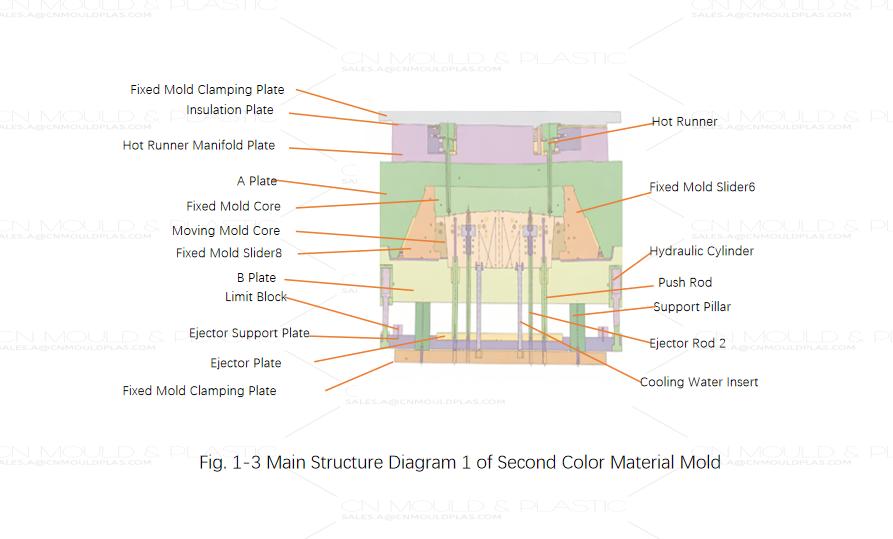
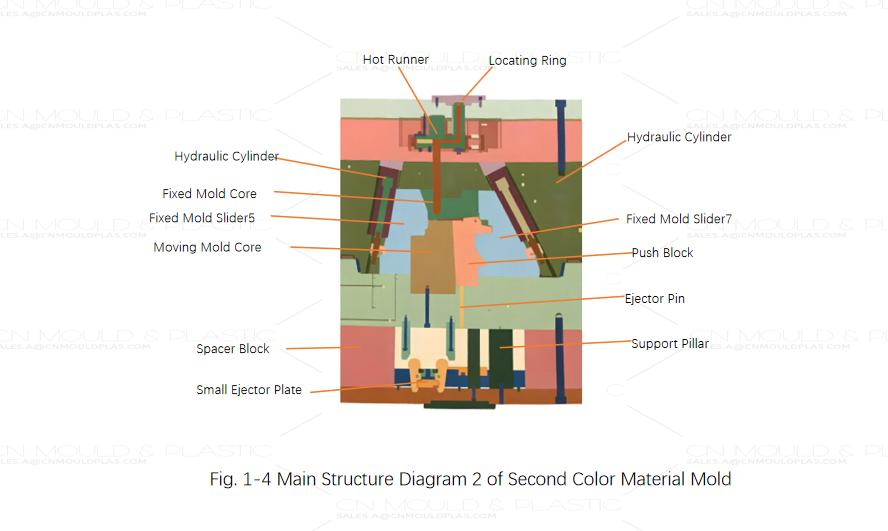
The main structural diagrams of the mould for the first color (PP+30%GF compound) are shown in Figure 1-1 and Figure 1-2, while the key structural drawings of the mould for the second color (TPE compound) are presented in Figure 1-3 and Figure 1-4. These structural designs are tailored to the material characteristics of PP+30%GF and TPE, as well as the waterproof performance requirements of the final product, ensuring the forming accuracy and structural stability of each color of the product during the injection moulding process.
For this two-color waterproof mould, high-performance mould steels are selected for all core components, and strict heat treatment technical requirements are formulated according to the different stress conditions and functional positioning of each part, so as to guarantee the mould’s wear resistance, toughness and service life under long-term production conditions. The detailed material and heat treatment specifications of each key component are as follows:
Fixed mould cavity: Made of 1.2344 material, with heat treatment requirement of double tempering after quenching, and the hardness is controlled at 48~50HRC.
Moving mould core: Adopting 1.2344 material, the heat treatment process requires double tempering after quenching, with the hardness standard of 46~48HRC.
Fixed mould slide: Processed from 1.2344 material, it needs double tempering after quenching during heat treatment, and the hardness is set at 50~52HRC.
Push block: Using 1.2344 material, the heat treatment requires double tempering after quenching, with the hardness reaching 50~52HRC.
Lever:Adopting 1.2344 material, tempered after quenching during heat treatment, with the hardness standard of 50~52HRC.
Pull hook: Processed from 1.2344 material, it is tempered after quenching in heat treatment, and the hardness is set at 50~52HRC to ensure the structural strength during the mould opening and closing process.
Control lever: Made of 01 material, with heat treatment requirement of tempering after quenching, and the hardness is as high as 54~56HRC, adapting to the high precision control demand of the mould’s mechanical movement.
The rational matching of material selection and heat treatment hardness for each mould component is not only the key to ensuring the mould’s own machining accuracy and service life, but also an important guarantee for the forming quality of waterproof products. For waterproof components, the mould’s dimensional stability and surface precision directly affect the product’s sealing performance; the high-hardness and wear-resistant mould components can avoid dimensional deviation caused by mould wear during mass production, thus ensuring the consistent waterproof effect of each product.
In the follow-up research and development of waterproof moulds, we will continue to optimize the material combination and heat treatment process according to the actual production feedback and the upgrading demand of waterproof product performance, and combine the structural characteristics of two-color injection moulding to further improve the mould’s adaptability and production efficiency, so as to provide more reliable mould support for the research and development and production of high-performance waterproof products.
At the same time, this material and heat treatment specification system can also provide a reference for the design and manufacturing of similar two-color waterproof moulds, helping the industry to improve the standardization and scientificity of mould design, and promoting the overall development of the waterproof product manufacturing industry.

 English
  français
  Deutsch
  Español
  italiano
  русский
  português
  العربية
  dansk
dansk  Suomi
Suomi  Svenska
  norsk
norsk