Wall thickness of consumer products is usually not uniform. Generally, when mold designers are choosing gating position, they would start looking for a relatively thicker section and place the gate closer to it.
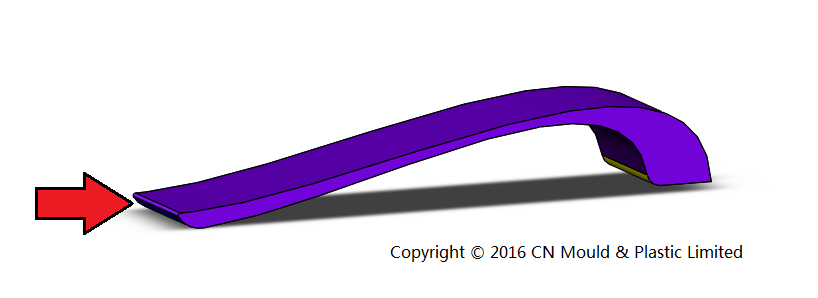
Fig.1
Why “Thin to Thick” causing a problem?
The thicker section of the molding requires more packing, i.e. it needs more time to fill. Hence, when the gate is place at the thinner section, as shown in Fig.1, the transition area between thick and thin would freeze off before the melt fully fill the thicker if the flow length is large. Also, the melt would tend to jet when it first enters the thicker section and cause bad surface finishes.
“Thick to Thin” also Problematic
However, blindly applying general rules is not wise. “Thick to thin” also cause problems in some scenarios. Considering an edge gate shown as in Fig.2, jetting occurs as the melt stream into the open cavity and result in a poor appearance. Jetting would also lead to poor strength as the melt weld not well.
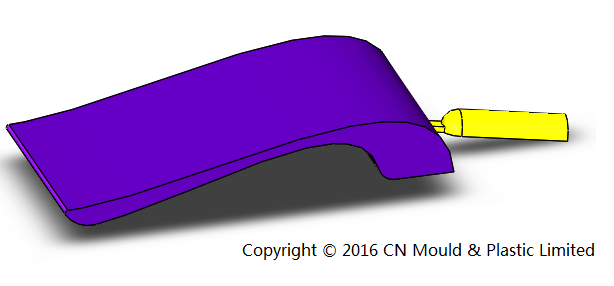
Fig.2
Be Flexible and Solve!
Adjusting melt entering angle is helpful for solving the above jetting problem. The aim is to obstruct the high-speed flow when it enters the cavity and attain a shorter land length. Other ways include inserting pins if there are holes in the thicker section and adjusting gate size could also be considered if appropriate.


 English
  français
  Deutsch
  Español
  italiano
  русский
  português
  العربية
  dansk
dansk  Suomi
Suomi  Svenska
  norsk
norsk