In injection mold design, lifters (also called angled core pullers) are often long and slender. They must withstand repeated sliding and bending forces during ejection. When space is tight and the lifter cannot be made thicker, the only practical solution is to strengthen the lifter itself.
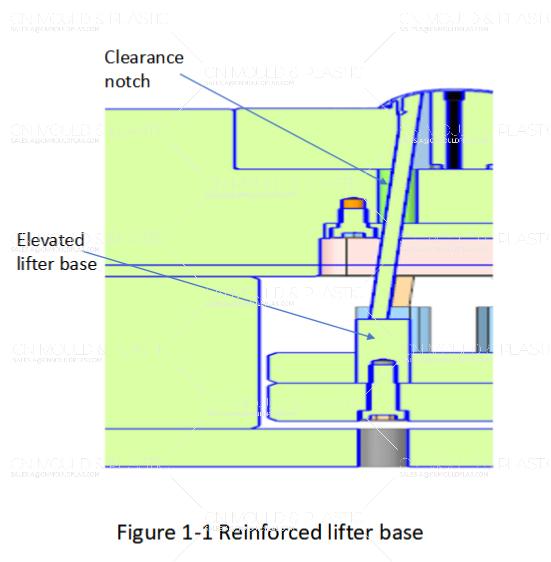
Figure 1-1 shows a typical situation — the lifter cannot be widened to the left or right, so the only option is to reinforce the lifter along its length. Removing material from the non-critical side reduces the effective span and significantly improves strength and rigidity. The trade-off is that a large cutout is often required in the rear mold plate to make room for the reinforced lifter base.
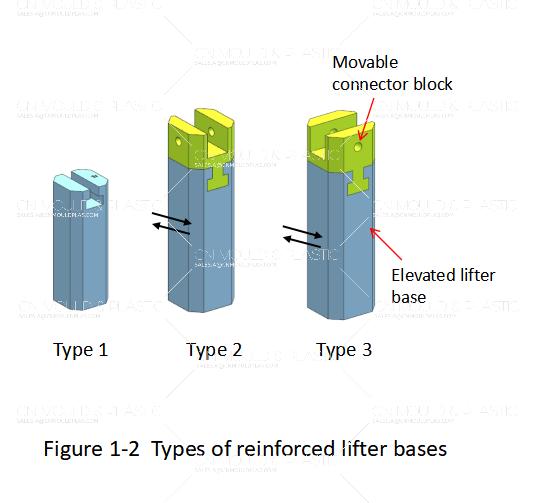
Once the lifter is strengthened, the base that connects it to the ejection system must also be designed properly. Figure 1-2 shows the three most common lifter base designs.
The first type is the T-slot base, a simple and robust design. A T-shaped ear is cut into the lifter bar, and a matching T-slot is cut into the base. The lifter slides into the base and is held securely. This works well when the lifter bar is wider than 6 mm.
The second and third types are pin-connected bases, used when the lifter is narrow or thin. A sliding connector block is cut into the top of the base, and a pin hole is added. The lifter is inserted into the block and secured with a pin. This approach suits lifter bar with a width or thickness between 1 mm and 6 mm. Both designs provide smooth sliding motion and a secure connection — even when the lifter is too small for a T-slot.
The key takeaway: when mold space limits lifter thickness, strengthen the bar by reducing its unsupported span. Then match the base type to the lifter size — T-slot for larger lifters, pin-connected for smaller ones. Good lifter design prevents breakage and ensures reliable ejection over millions of cycles.

 English
  français
  Deutsch
  Español
  italiano
  русский
  português
  العربية
  dansk
dansk  Suomi
Suomi  Svenska
  norsk
norsk