O-rings are the most commonly used sealing elements in mold cooling systems. When they fail, water leakage or seepage can occur, leading to mold damage and production downtime. This article explains why O-rings leak and what the seal groove design requires.
1. Common Causes of O-Ring Leakage
O-ring leakage generally results from one of three factors: incorrect groove dimensions, material issues, or assembly problems.
1.1 Incorrect Groove Dimensions or Manufacturing Errors
The sealing principle of an O-ring is based on proper compression. When the groove dimensions are incorrect, sealing fails.
1) Under no pressure, the O-ring sits loosely in the groove.
2) Under pressure with a correctly sized O-ring, the O-ring achieves four‑point contact, creating an effective seal.
3) If the O-ring is too large, it may appear to seal initially when screws are tightened. However, over time, as the rubber ages and screws loosen, leakage will gradually occur.
4) If the seal groove is oversized, the O-ring cannot be sufficiently compressed, leading to direct leakage.
1.2 Incorrect O-Ring Specifications or Rubber Aging
Using an O-ring with the wrong cross‑section diameter or inner diameter will prevent proper sealing. Additionally, prolonged exposure to high temperatures and pressures causes rubber to harden, crack, and lose elasticity, resulting in seal failure.
1.3 Assembly Issues
Leakage can also occur if the mold plate screws are not tightened sufficiently or if the water fitting dimensions do not match the O-ring properly.
2. O-Ring Groove Design Requirements
To ensure reliable O‑ring sealing, the seal groove must meet the following four requirements:
2.1 Trapezoidal Groove Shape
The cross‑section of the O‑ring groove should be trapezoidal, not rectangular. The trapezoidal shape helps with O‑ring installation and positioning, and provides better sealing performance under compression.
2.2 Correct Groove Dimensions
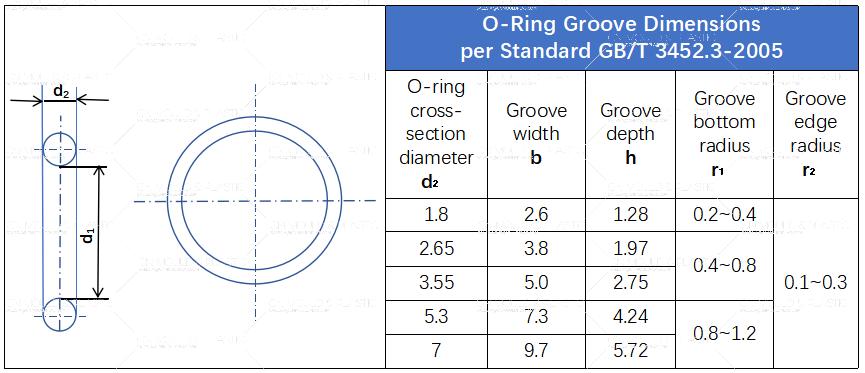
The width and depth of the groove must match the cross‑section diameter of the O‑ring to ensure the appropriate compression ratio, as shown in the Figure.
2.3 Compatibility with Forming Tools
O‑ring grooves require specialized forming tools for machining. Groove design must consider the machinability of these tools to ensure that features such as sharp bottom corners can be properly achieved.

 English
  français
  Deutsch
  Español
  italiano
  русский
  português
  العربية
  dansk
dansk  Suomi
Suomi  Svenska
  norsk
norsk