Waterproofing is critical in electronic products to prevent moisture damage like short circuits and corrosion. As user expectations rise, waterproof design has become a standard part of product development.
Keypads are essential for user interaction. Among the common types (silicone, P+R, and film), this article focuses on silicone keypads.
Why Silicone Keypads?
Silicone keypads are molded in one piece, combining the key and the elastic base into a single component. They offer several advantages: easy one‑step molding, low cost, and good tactile feel. However, they also have some drawbacks, such as high elasticity, significant force loss, and limited appearance options. As a result, they are often used in cost‑sensitive products.
Waterproof Structures for Silicone Keypads
Silicone hardness is typically measured on the Shore A scale. For panel keypads, a hardness of 60±5 is common; for side keys, 50±5 is recommended. The actual value can be adjusted based on the specific product requirements.
Comparison of Two Silicone Keypad Waterproofing Structures |
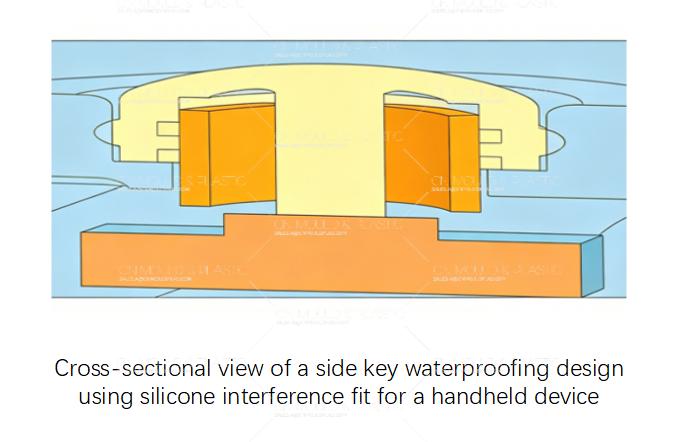
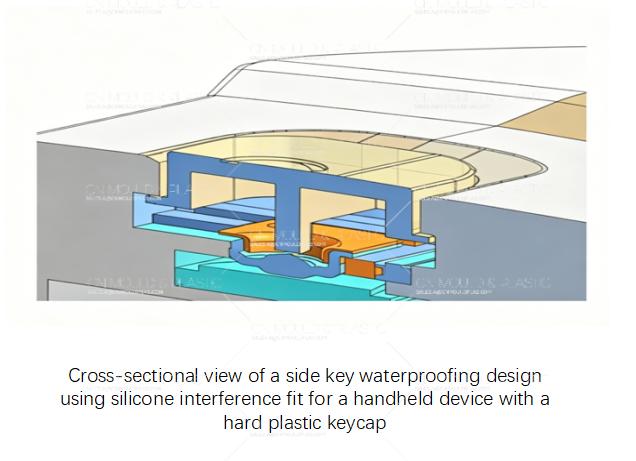
Feature | Structure 1: Screw Fixing | Structure 2: Interference Fit (Side Key) |
Best application | Large keys or ample internal space | Small side keys with tight space |
Fixing method | Screws through PCB or pressure plate | Direct press-fit into housing |
Sealing feature | Sealing rib around keypad (radius ≥ 0.5 mm) | Single-side contact |
Interference fit | 0.15 – 0.30 mm (full rib) | 0.15 – 0.30 mm (single side) |
Sealant | Thin layer of 706 silicone in housing groove | Optional (not required) |
Rigidity requirement | High – need to reinforce PCB and structure | Low – limited space, simple design |
Extra component | Pressure plate between PCB and housing if needed | Soft-hard composite (hard plastic or metal guide) |
Assembly precaution | Even screw boss spacing | Fool-proof design for silk-screened keycaps |
Typical application example | Large panel buttons on handheld devices | Side buttons on handheld devices |
Waterproof Adhesive or Backing Adhesive
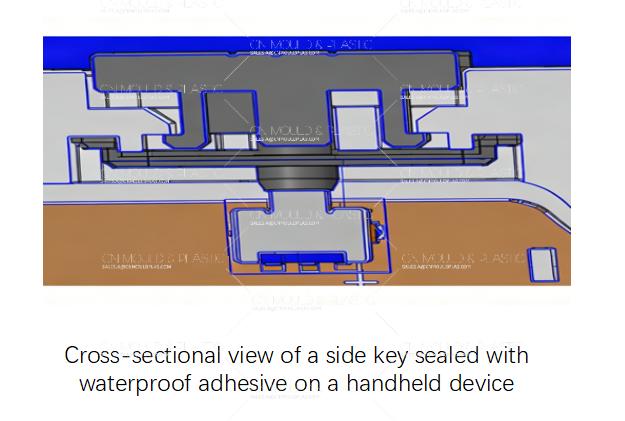
How it works: Apply a thin layer of 706 adhesive in the keypad groove, then seal the sides. Leave enough space for adhesive dispensing.
Benefits: 706 adhesive is water‑repellent, durable, and elastic (absorbs vibration).
Tip: Add a limiting design to prevent over‑deformation.
For membrane keypads: Use waterproof backing adhesive with a width ≥2 mm on a clean, flat surface.
Injection Molding Waterproofing (Seamless)
How it works: The housing and keypad are molded together as one piece.
Pros: High waterproof performance, good appearance, high efficiency.
Cons: High cost, strict material/process requirements, poor repairability.
Common soft materials: TPE, TPU, silicone, POM.
Substrates: PC, PA, PET, PPSU, aluminum, stainless steel, copper.
Two methods:
①Two‑shot molding: wo different materials are injected sequentially on the same specialized injection molding machine, usually in a single mold. The part is ejected only once, and no manual handling is required between shots.
②Overmolding: The first part is molded, manually removed, and then placed as an insert into a second mold for the second shot. This process uses two separate molds and a standard injection molding machine, but requires manual handling.

 English
  français
  Deutsch
  Español
  italiano
  русский
  português
  العربية
  dansk
dansk  Suomi
Suomi  Svenska
  norsk
norsk