Cantilever snap‑fits are one of the most common joining methods in plastic part design. They consist of a beam that deflects during assembly and snaps into a mating component, providing a simple and cost‑effective fastening solution.
Removable vs. Non‑Removable Designs
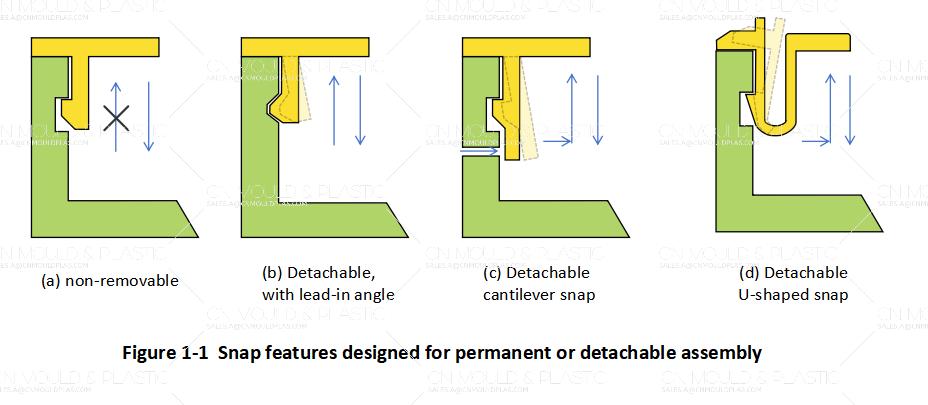
Cantilever snap‑fits can be designed as either non‑removable or removable, depending on the application requirements.
Figure 1-1a illustrates a non‑removable design, where the joint is intended to be permanent. In contrast, Figure 1-1b shows a removable design, achieved by adding a return angle that allows the component to be disengaged with relative ease.
For applications requiring periodic disassembly — such as maintenance or repair — a 90° return angle can be incorporated (see Figures 1-1c and 1-1d). This design allows the component to be separated intentionally while still providing secure retention during normal use.
Molding and Locking Characteristics
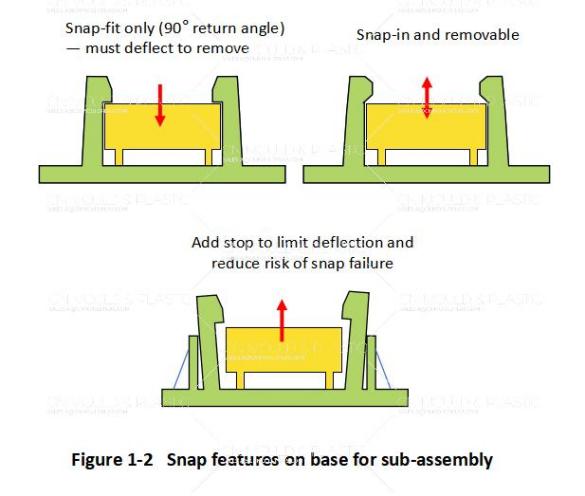
Cantilever snap‑fits are often molded directly onto the product base, as shown in Figure 6-21. The design typically features a 90° return angle, which locks the mating component securely in place.
However, a variant with a shallow return angle (less than 90°) offers a different function — it provides slight pre‑loading and constant pressure on the mating part. This design allows the component to be removed by pulling axially, which can be convenient for maintenance access. On the downside, shallow return angles are more susceptible to loosening under impact loads — such as vibration during transportation — which may cause the assembly to come loose unexpectedly.
Mechanical Considerations: Push‑in and Pull‑out Forces
Push‑in and pull‑out forces are critical design parameters for snap‑fit joints. Among the variables that influence these forces, beam length and entry angle have the most significant impact.
Cantilever snap‑fits are widely used in electrical applications — for example, mounting circuit boards or power supplies onto molded chassis. When using 90° return angle snap‑fits that require manual deflection for disassembly, it is recommended to incorporate stops or retainers to limit beam deflection and prevent potential damage to the snap‑fit during service, as shown in Figure 1-2.

 English
  français
  Deutsch
  Español
  italiano
  русский
  português
  العربية
  dansk
dansk  Suomi
Suomi  Svenska
  norsk
norsk