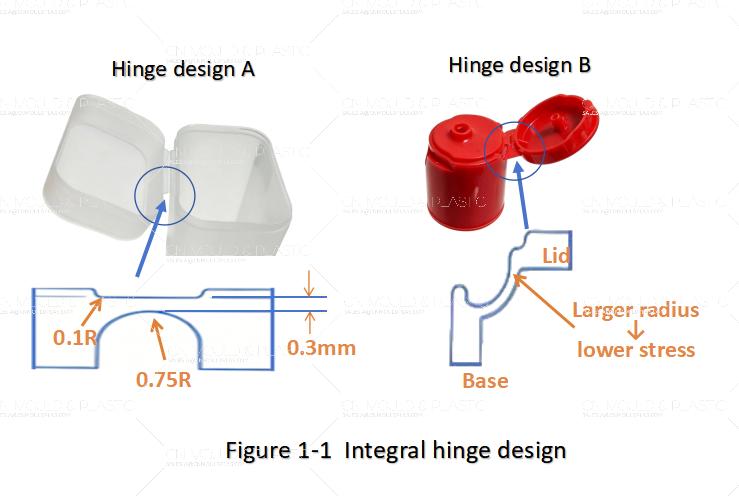
A living hinge is a very thin, flexible structural feature molded as an integral part of a plastic product. It is commonly used in plastic containers to connect a lid directly to the body( see Figure 1-1). Living hinges are most often made from polypropylene, though other tough plastics can also be used. When properly designed and molded, a polypropylene living hinge can withstand hundreds of thousands of flex cycles.
The strength and durability of a living hinge come from the high molecular orientation of the polymer chains achieved during molding. This orientation is critical — poor flowability or the presence of a weld line in the hinge area will lead to premature failure.
Design Variations
Living hinges come in several styles. They are typically very thin and short strips used to connect two parts — such as a box and its lid. The thickness is usually only about 0.3 mm, with a width of less than 1.0 mm (see Design A in Figure 1-1). These hinges generally allow bending up to 180° and can close tightly with a very small radius.
Alternatively, a thicker, discontinuous hinge design may be used. These are more like straps — longer and wider — allowing folding with a larger bend radius (see Design B in Figure 1-1). However, they typically require more clearance to close fully.
Molding Considerations
Careful attention must be paid to gate placement and melt flow when molding living hinges. For container and lid assemblies, the gate is typically placed on the larger body section, well away from the hinge area. Ideally, the melt should reach the hinge last, and the flow front should approach the hinge perpendicularly, running parallel to the hinge line. This design helps the melt reach the narrow hinge region without hesitation.
If the melt front arrives at the hinge while other areas of the cavity are still filling, it may stall or solidify prematurely — leading to weak molecular orientation and reduced fatigue life.
Packing Pressure and Shrinkage
Another potential issue is packing pressure imbalance. During the packing phase, the thin hinge solidifies quickly, while the thicker lid section remains molten. If packing is not properly controlled, the lid may shrink at a different rate than the container body, causing:
Unsightly sink marks
Internal voids
Loss of surface gloss
If gates are placed on both sides of the hinge to improve packing, special care must be taken to avoid creating a weld line directly on the hinge — as this would severely weaken the part.

 English
  français
  Deutsch
  Español
  italiano
  русский
  português
  العربية
  dansk
dansk  Suomi
Suomi  Svenska
  norsk
norsk