When designing thermoplastic gears, it is essential to remember that the gear must not only meet its mechanical function but also be dimensioned for correct and efficient injection molding. Simpler geometries fill more reliably and can achieve tighter tolerances when required.
Rim, Web, and Hub Proportions
To provide adequate mechanical strength, the rim section supporting the gear teeth should have a wall thickness at least equal to the full tooth height (h). The vertical cross‑sections beneath the rim and hub walls depend on the functional requirements of the gear, as well as the gate type and location.
Figure 1-1(a) shows a diaphragm gate located at the center of the hub of a spur gear. In this design, it is recommended that the center wall thickness be 20% greater than the rim, and the vertical web section be 10% greater.
Figure 1-1(b) shows a spur gear with 3 or 4 pin‑point gates in the web (using a three‑plate mold). Here, the web wall thickness should be 20% greater than the rim, while the hub wall thickness should be 10% greater.
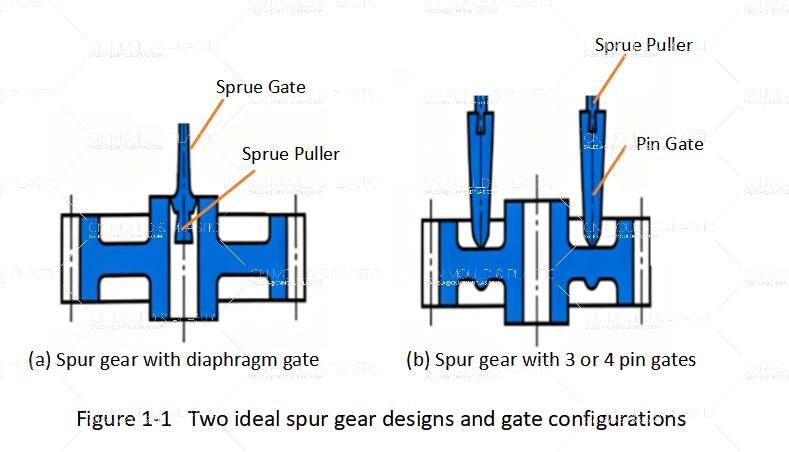
Following these proportional guidelines — combined with appropriate gate placement — helps achieve excellent dimensional control, including runout tolerances, without warpage.
The Importance of Symmetry
Gears are precision mechanical components. Any inaccuracy can affect smooth operation and load‑carrying capacity. Therefore, every effort must be made to eliminate potential sources of error during design.
The overall design goal should be to achieve symmetry while avoiding excessive variations in tooth thickness. Figure 1-2 shows examples of poor designs that violate this principle.
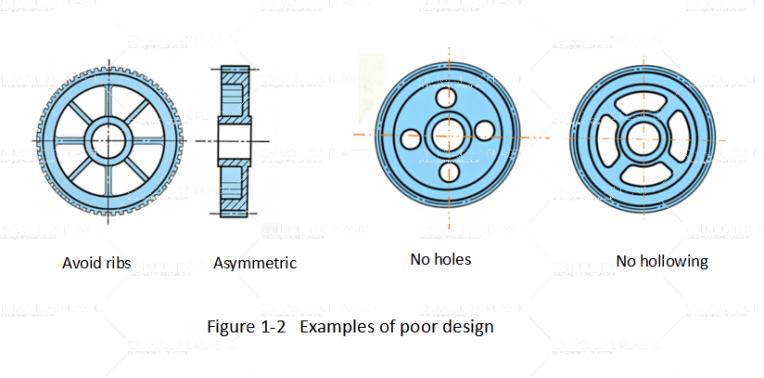
A recommended approach is to base the gear proportions on a standard unit of tooth thickness. The connection between the gear ring and the hub is typically made through a web. The symmetry of this web is critical to the precision of the molded gear. An eccentric or one‑sided web design can lead to gear distortion.
Likewise, to preserve gear accuracy, it is advisable to avoid using ribs to reinforce the web, or perforations and spokes to reduce weight. These features can cause uneven shrinkage, which distorts the roundness of the gear teeth.

 English
  français
  Deutsch
  Español
  italiano
  русский
  português
  العربية
  dansk
dansk  Suomi
Suomi  Svenska
  norsk
norsk