When designing molded threads for plastic parts, the goal is to achieve reliable function without compromising part strength or manufacturability. Unlike metal threads, plastic threads require special consideration due to material behavior, molding constraints, and stress sensitivity. Below are key design guidelines to follow.
1. Use Maximum Allowable Radii at the Crest and Root
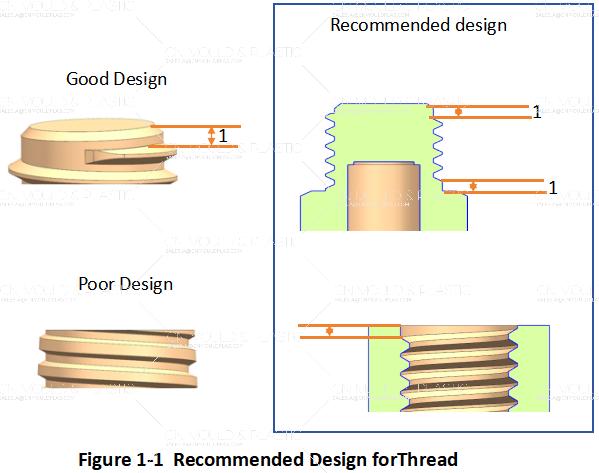
Sharp corners act as stress concentrators. By using the largest possible radius at both the thread crest (outer diameter) and root (inner diameter), you reduce stress concentration and improve moldability. This also helps maintain material flow during filling.
2. Avoid Running Threads All the Way to the End
Threads that terminate abruptly leave a thin, weak "feather edge" that is prone to cross‑threading and damage. Always leave a short unthreaded section at both ends of the thread, as shown in Figure 1-1. This improves strength, simplifies molding, and reduces the risk of misalignment during assembly.
3. Keep Thread Pitch Above 0.8 mm
For ease of molding and to prevent cross‑threading during assembly, limit the thread pitch to a minimum of 0.8 mm. Finer pitches are more difficult to mold and are more susceptible to damage during handling and assembly.
4. Avoid Tapered Threads Unless a Stopper Is Provided
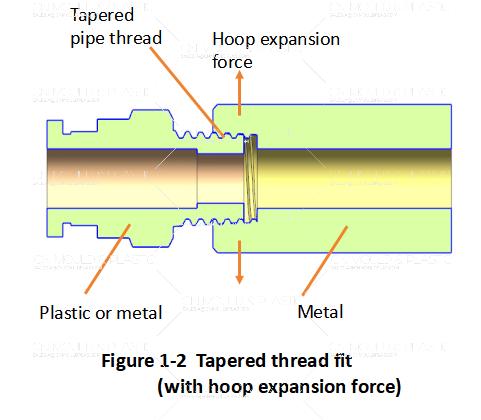
Tapered pipe threads (commonly used in fluid systems) exert radial hoop stress on plastic parts, as shown in Figure 1-2. This stress can exceed the material's safe limit and cause cracking, especially in brittle plastics.
When mating a plastic internal thread with a metal tapered external thread, consider one of the following alternatives:
Additional caution: Thread sealants or thread‑locking compounds may attack certain plastics, particularly amorphous resins like PC and ABS. Always verify chemical compatibility before use.
5. Consider Special Thread Designs for Plastic
For optimal performance, use threads specifically designed for plastic applications. When the thread does not need to mate with standard metal threads, custom designs can better suit the application and material requirements.
Example 1 – Medical locking connectors:
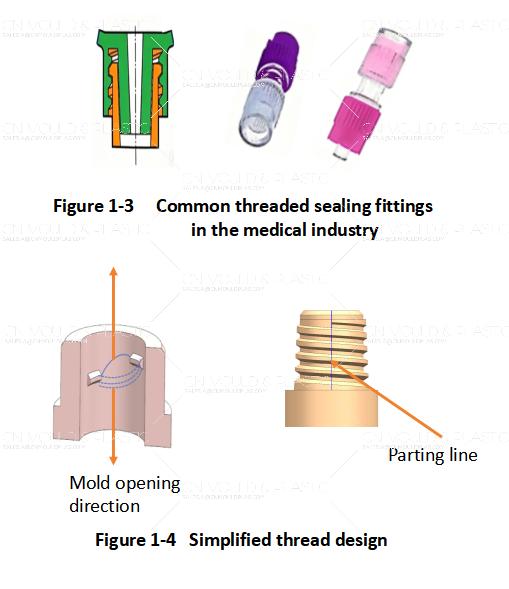
Special plastic thread designs have been developed for luer‑type fittings in the medical industry. These designs ensure reliable locking without over‑stressing the plastic components (see Figure 1-3).
Example 2 – Simplified thread designs:
To reduce molding complexity and cost, simplify the thread profile where possible. Figure 1-4 shows examples of plastic‑friendly thread designs that maintain function while improving manufacturability.

 English
  français
  Deutsch
  Español
  italiano
  русский
  português
  العربية
  dansk
dansk  Suomi
Suomi  Svenska
  norsk
norsk