Plastic bearings are load‑bearing moving components in which relative motion occurs between the plastic part and other mating parts. Proper structural and dimensional design is critical for performance, longevity, and reliability.
1. Bearing Clearance
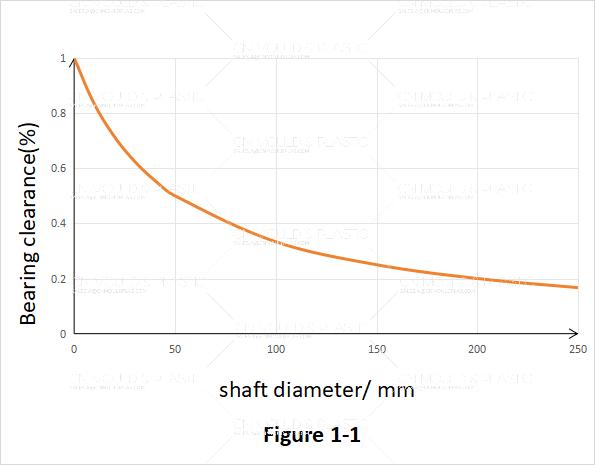
Bearing clearance is the minimum gap required between the bearing bore diameter and the shaft diameter under optimal conditions. This clearance ensures that the bearing can operate normally without seizing. Figure 1‑1 illustrates bearing clearance expressed as a function of the bearing diameter.
2. Bearing Wall Thickness
Ideally, bearing wall thickness should be kept small to promote good heat dissipation and dimensional stability. A reliable empirical relationship gives the wall thickness as:
t = 0.4d
t is the wall thickness
d is the shaft diameter (or bearing inner diameter).
3. Typical Grooved Bearings
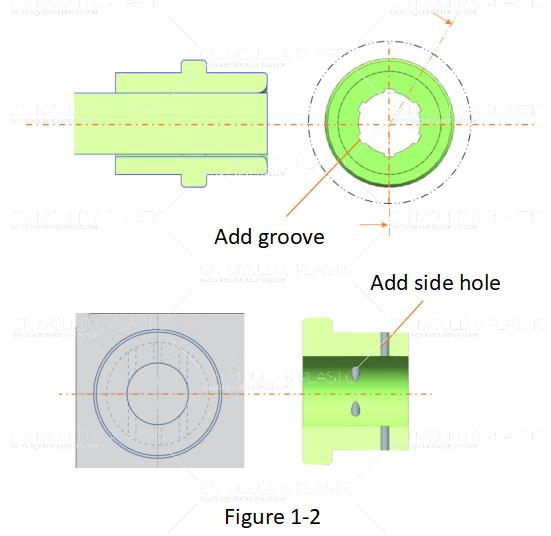
Extending service life depends largely on removing abrasive wear debris from the sliding interface. As shown in Figure 1‑2, the following design guidelines for grooved bearings are recommended:
Use at least three grooves.
Make grooves as deep as possible.
Groove width should be approximately 10% of the shaft diameter.
Where side walls are too thin to accommodate grooves, use through holes instead.
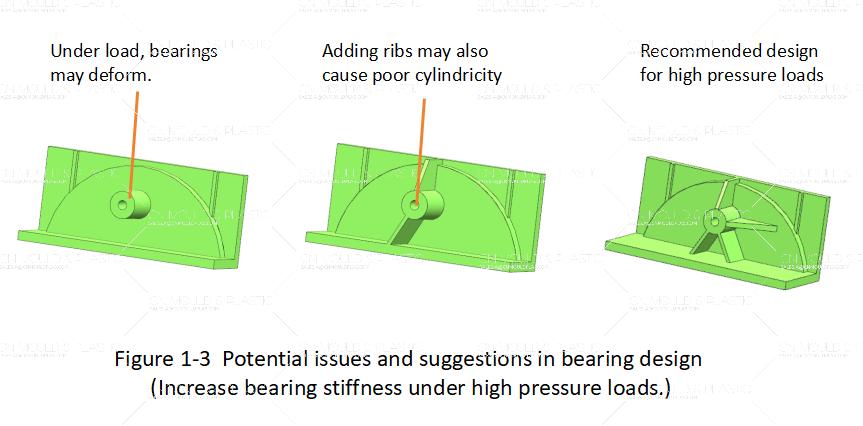
Another important factor is that the bearing pressure load must be distributed evenly over the axial length. Figure 1‑3 shows common design problems and recommended improvements for bearing design.

 English
  français
  Deutsch
  Español
  italiano
  русский
  português
  العربية
  dansk
dansk  Suomi
Suomi  Svenska
  norsk
norsk