When selecting a plastic material for a specific application, glass transition temperature (Tg) is one of the most important properties to consider.The transition from a glassy state to a rubbery state is a fundamental characteristic of amorphous plastics. During this transition, the material's volume, hardness, elongation, and modulus change dramatically.
What Is Glass Transition Temperature?
The glass transition temperature (Tg) is the temperature below which a plastic behaves like a glassy or crystalline solid, and above which it behaves like a rubbery material. In simpler terms, it is the temperature at which polymer chains begin to gain significant mobility. Below Tg, molecular motion is largely frozen; above Tg, chains can move and slide past one another.
How Tg Affects Material Selection
The performance of a plastic can vary significantly depending on whether it is used above or below its Tg.
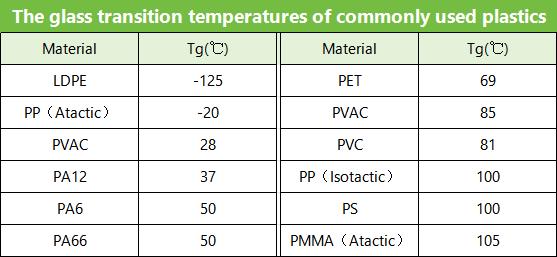
Hard plastics such as PS and PMMA are typically used below their Tg. At room temperature, they are in a glassy state — rigid, strong, and dimensionally stable. Their Tg values are around 100°C, which is well above typical service temperatures.
Rubbery elastomers such as polyisobutylene (PIB) and natural rubber are used above their Tg. At room temperature, they are soft, flexible, and resilient. Cross‑linking provides them with a fixed shape even in their rubbery state.
A Familiar Example: Chewing Gum
You have probably experienced the glass transition of chewing gum. At body temperature, gum is soft and pliable — characteristic of a rubbery amorphous solid. However, if you drink a cold beverage or place an ice cube on it, the gum turns rigid and brittle. This happens because the Tg of chewing gum lies somewhere between 0°C and 37°C.
This everyday example illustrates how dramatic the change in material properties can be across the glass transition.
Common Plastics and Their Tg Values
The table below lists the glass transition temperatures of commonly used plastics. This reference is useful for matching material properties to application temperature requirements.
How to Select Materials Based on Tg
Choosing the right plastic requires understanding how Tg relates to your product's service temperature. Here are five practical guidelines:
① For structural strength at room temperature – Choose a plastic with Tg well above the maximum service temperature. Such as PS (Tg ≈ 100°C) is fine for indoor, non‑load‑bearing parts.
② For impact resistance or flexibility – Choose a plastic with Tg below the service temperature, or use a rubber‑modified grade. Nylon (Tg ≈ 50°C) is tougher at room temperature than PS or PMMA.
③ For wide temperature fluctuations – Select a material with Tg far outside the expected range, or use semi‑crystalline plastics like POM or PET, which maintain properties above Tg due to crystallinity.
④ For transparency – Choose amorphous plastics, but ensure Tg is above the service temperature to maintain clarity and dimensional stability. PC, PMMA, and PS are transparent and glassy at room temperature.
⑤ For sealing or gasket applications – Choose materials with Tg below room temperature, such as elastomers. Their rubbery behavior allows them to conform to surfaces and provide effective sealing.

 English
  français
  Deutsch
  Español
  italiano
  русский
  português
  العربية
  dansk
dansk  Suomi
Suomi  Svenska
  norsk
norsk