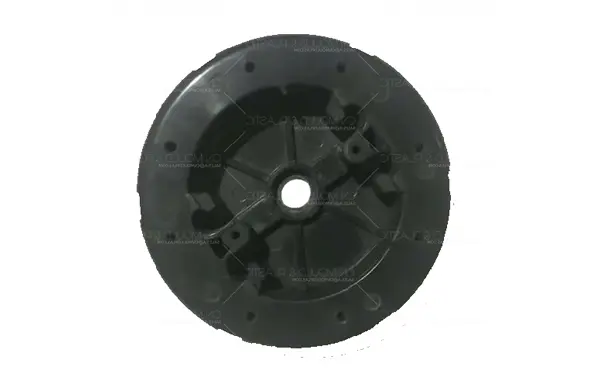
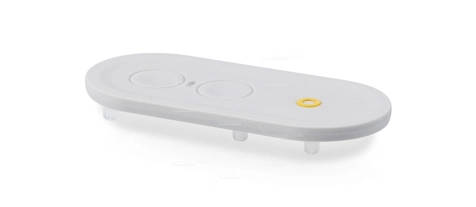
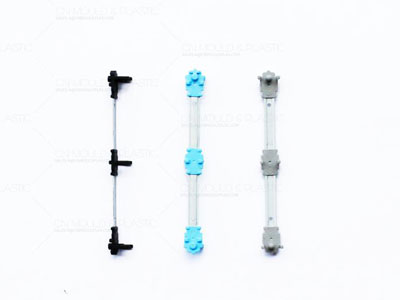
When selecting wall thickness for a plastic part, its moldability must be considered. The flow length — defined as the distance from the gate to the last filling area — must stay within the allowable range of the chosen material.
If the wall is too thick, cycle times may be extended and filling issues can also occur. When designing part wall thickness, pay attention to the following points:
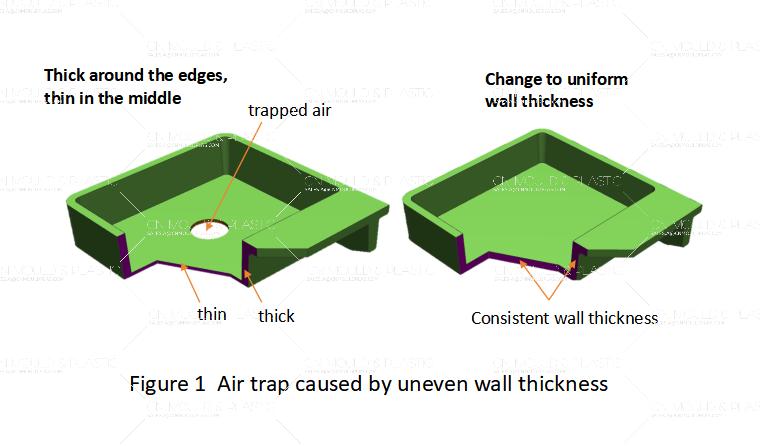
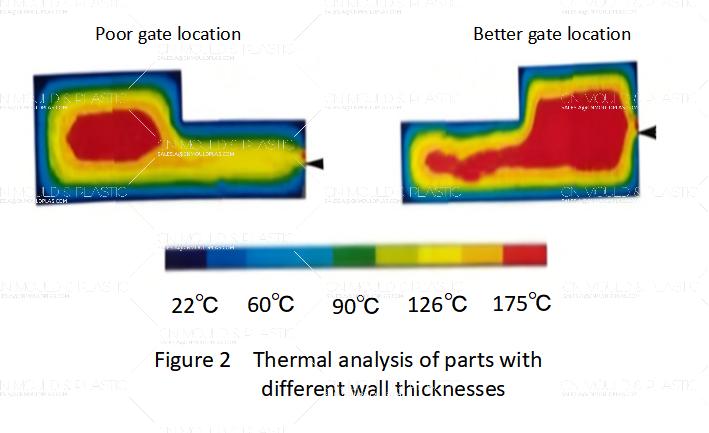
Avoid transitions that force melt to flow from thin to thick sections. When wall thickness must change, it is best to place the gate in the thicker region so that plastic flows from thick to thin. This minimizes the risk of sink marks and voids in the thicker areas, and helps control shrinkage, as shown in Figure 2.
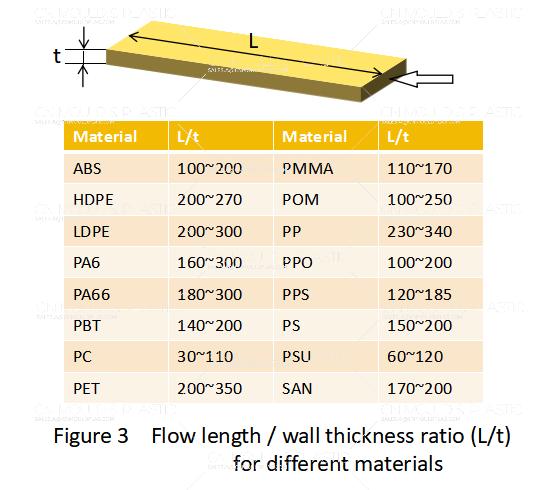
On the other hand, if the wall is too thin, it can lead to high molding stresses, surface defects, and filling problems, thereby narrowing the processing window. As shown in Figure 3, the allowable flow length to wall thickness ratio (L/t) varies significantly between different materials.
Thin‑Wall Molding Considerations
Thin‑wall parts — typically those with a nominal wall thickness below 1.5 mm — may require special high‑performance molding equipment to achieve the necessary fill speed and injection pressure. This can increase molding costs, which may offset any material savings.
Thin‑wall molding is therefore better suited for applications where size reduction or weight reduction is the primary goal, rather than cost saving.
If the flow length to wall thickness ratio of a part is too high for conventional molding, then a part with a wall thickness greater than 2 mm can also be considered a thin-wall part.

 English
  français
  Deutsch
  Español
  italiano
  русский
  português
  العربية
  dansk
dansk  Suomi
Suomi  Svenska
  norsk
norsk