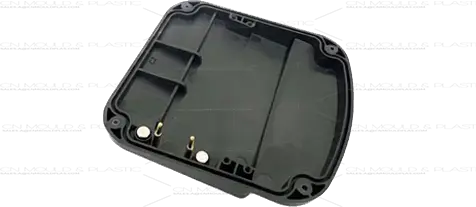
Bosses play a critical role in many plastic part designs, serving as connection and assembly points for screws, inserts, or other components. Proper boss design ensures mechanical strength while avoiding common defects such as sink marks and stress concentration.
Design Parameters
When designing a boss, the following basic parameters should be considered:
Outer diameter – Typically within 2.0 to 2.4 times the inner diameter
Spacing between bosses – At least 2 times the nominal wall thickness
Draft angle – 0.25° for the inner diameter, 0.50° for the outer diameter
Boss height – should not exceed 3 times the outer diameter
Design Recommendations to Prevent Sink Marks
To reduce sink marks on the opposite surface of the boss, the ratio of boss wall thickness (T) to nominal wall thickness (t) should follow the same guidelines used for rib design.
To minimize stress concentration and reduce the risk of fracture, the base of the boss should feature a smooth radius transition instead of a sharp edge. The radius at the boss base should be between 0.25 and 0.5 times the nominal wall thickness. While a larger radius helps reduce stress concentration, it may increase the likelihood of sink marks or voids.
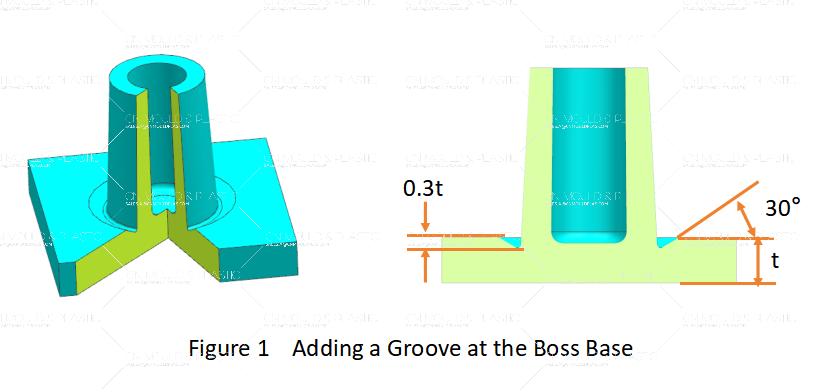
Using smaller screws or inserts is an effective way to avoid excessively thick boss walls. If the boss wall thickness exceeds the recommended ratio, consider adding grooves around the base of the boss (see Figure 1). These grooves reduce material accumulation and effectively alleviate sink mark issues.
Design Recommendations for Side Wall Connections
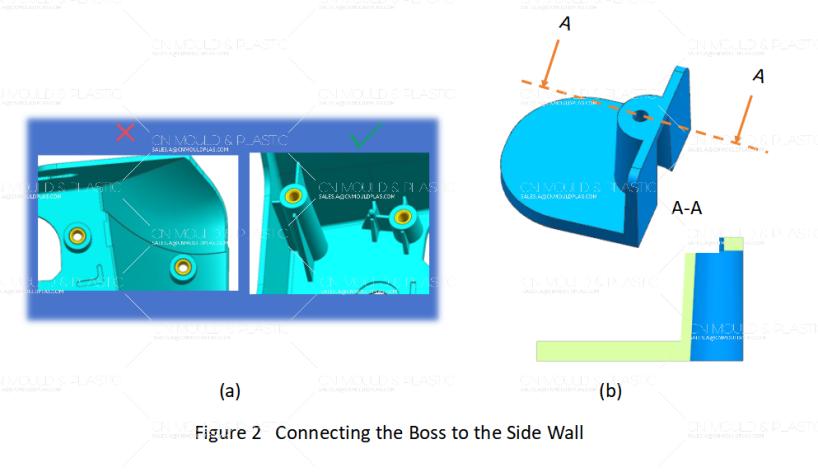
Directly merging a boss with a side wall should be avoided whenever possible. This type of structure creates thick sections that can lead to sink marks. Instead, position the boss at a reasonable distance from the side wall and use connecting ribs for support where necessary (see Figure 2(a) ).
When a boss must be located close to a side wall, an open design can be considered to optimize the structure and reduce the risk of sink marks (see Figure 2(b) ).

 English
  français
  Deutsch
  Español
  italiano
  русский
  português
  العربية
  dansk
dansk  Suomi
Suomi  Svenska
  norsk
norsk