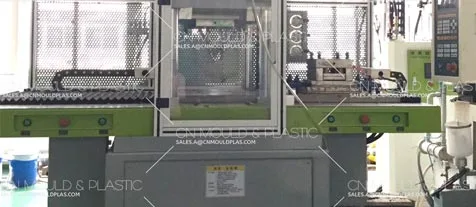
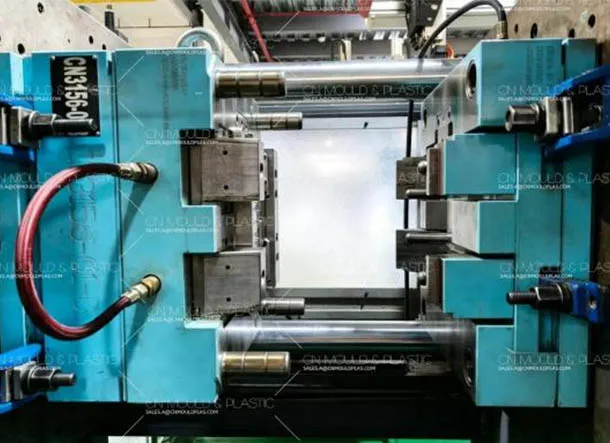
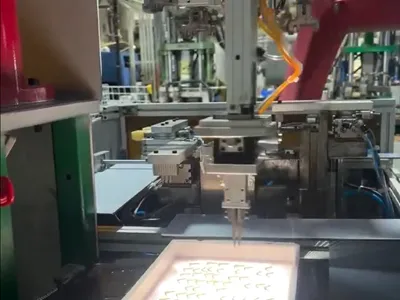
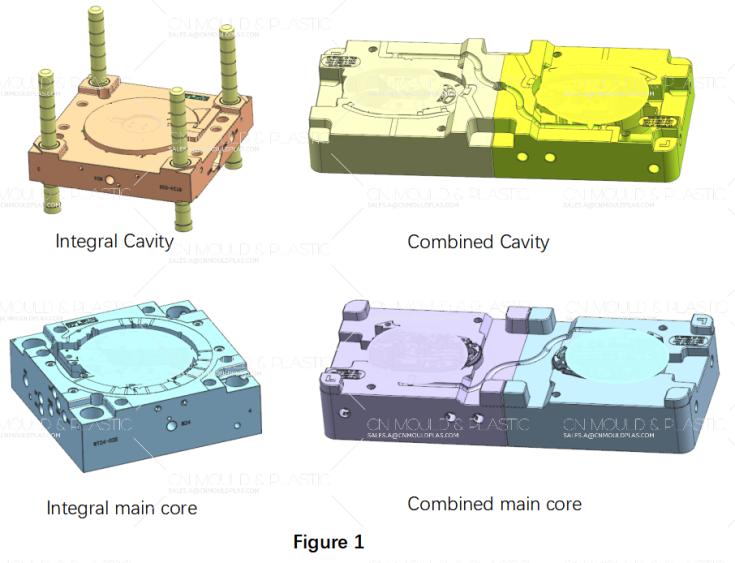
In injection mold design, the cavity and core are the primary components that shape the plastic part. The cavity forms the outer surface of the part, while the core forms the inner surface, as shown in Figure 1.
Below is a detailed look at their types, structures, and design considerations.
1. Cavity
The cavity is the main component that shapes the outer surface of the plastic part. It can be divided into two types based on its structure: integral (solid) and combined.
Integral Cavity
An integral cavity is machined from a single piece of metal. Its advantages are high strength, resistance to deformation, and no visible assembly lines on the molded part. For small to medium molds with simple shapes, integral cavities are the preferred choice.
Combined Cavity
A combined cavity is made up of two or more components. Depending on the assembly method, it can take several forms: integral insert, partial insert, side wall insert, or four‑wall assembly. Combined cavities are often used to simplify machining, maintenance, and heat treatment, or to save high‑grade steel.
When designing a combined cavity, the following requirements should be considered:
Easy machining, assembly, and maintenance – Convert complex internal shapes into external shapes whenever possible. Avoid long mating surfaces. Make wear‑prone parts as separate blocks for easy replacement.
Ensure strength and rigidity – Avoid thin walls and sharp corners in the combined structure.
Prevent transverse flash – Design should minimize the risk of flash forming horizontally.
Avoid visible assembly marks – No seam marks should remain on the plastic part that could affect its appearance.
Secure positioning and fastening – All combined components must be reliably located and firmly fixed.
2. Core
The core shapes the inner surface of the plastic part. Cores can be classified as main cores, small cores (or forming pins), thread cores, and thread rings.
Main Core
For simple containers such as shells or covers, the component that forms the main internal surface is called the main core. The main core can be either integral or combined.
Integral main core – Strong and rigid, but difficult to machine and consumes more mold steel. It is generally used for simple cores in small molds.
Combined main core – The core is machined separately and then assembled into the mold plate. This is more practical for complex or larger cores.
Small Core (Forming Pin)
Small cores are used to mold small holes or slots in the plastic part. They are manufactured separately and then inserted into the mold plate.
Thread Core (for Internal Threads)
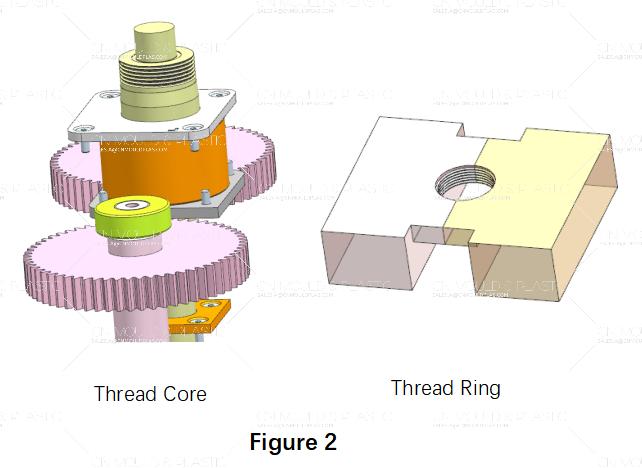
Thread cores are used for molded internal threads, as shown in Figure 2. Design include accounting for shrinkage, adding a 0.5° draft angle, and properly shaping thread ends to prevent damage. The core must stay securely in place during molding and be easy to remove with the part afterward.
Thread Ring (for External Threads)
A thread ring is a movable insert for molding external threads, as shown in Figure 2. It fits the mold plate with an H8/f8 clearance over a 3–5 mm length, with a 3°–5° taper beyond that for easy assembly. A split (two‑piece) thread ring allows fast removal with a wedge tool, but leaves a visible seam on the molded thread.

 English
  français
  Deutsch
  Español
  italiano
  русский
  português
  العربية
  dansk
dansk  Suomi
Suomi  Svenska
  norsk
norsk