Ribs are essential features in plastic part design. When designed correctly, they improve part performance without increasing wall thickness. Below are the main functions of ribs and key design guidelines to follow.
1. Functions of Ribs
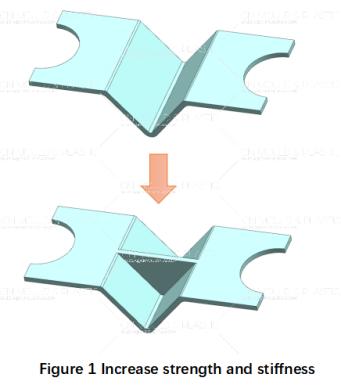
① Increase strength and stiffness
Ribs improve the rigidity of plastic parts without adding wall thickness, helping to prevent warpage and deformation, as shown in Figure 1.
② Improve melt filling
Properly arranged ribs enhance melt flow during filling, reduce internal stress, and help avoid defects such as voids, sink marks, etc.
③ Assist in assembly
Ribs can be used to secure or support other components during assembly.
2. Design Guidelines for Ribs
① Rib Dimensions (see Figure 2)
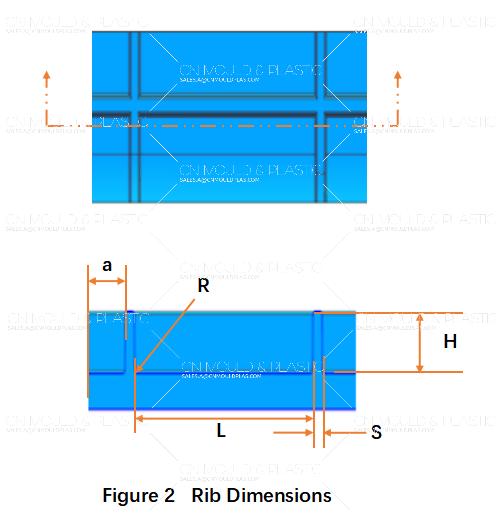
a. The spacing between ribs should be at least four times the wall thickness (L ≥ 4T), where T is the nominal wall thickness. This ensures adequate space to prevent sink marks.
b. Rib height should generally not exceed five times the wall thickness (H ≤ 5T). Excessively tall ribs increase venting difficulty during molding and raise material costs.
c. The rib width at the base should be between 0.5 and 0.8 times the wall thickness (S = 0.5–0.8T). If the rib is too thick, sink marks will appear on the opposite surface.
d. A root radius of approximately one-eighth of the wall thickness (R = T/8) is recommended. This radius improves melt flow and helps prevent stress cracking. However, if the radius is too large, it may also cause sink marks on the opposite side.
e. Ribs should be designed with the maximum possible draft angle to facilitate demolding. Typical draft angles range from 0.5° to 2°. For textured surfaces or complex geometries, a larger draft angle — up to 2° — is recommended, as complex parts create greater demolding resistance. Insufficient draft may cause surface drag marks.
② Symmetrical Arrangement
Ribs should be arranged as symmetrically as possible to avoid localized stress concentration within the part.
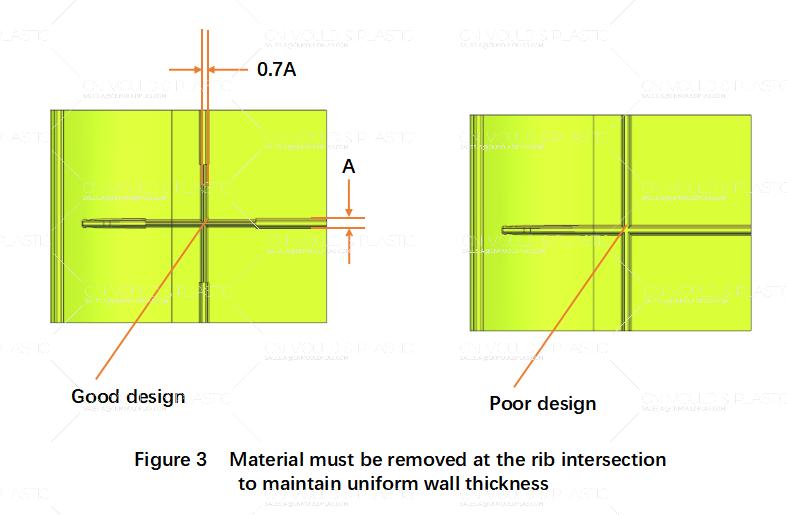
③ Avoid Thick Sections at Rib Intersections
Where ribs intersect, thick sections tend to form, which can lead to sink marks on the opposite surface. As shown in Figure 3, Material should be reduced at these intersections to maintain uniform wall thickness throughout the part.

 English
  français
  Deutsch
  Español
  italiano
  русский
  português
  العربية
  dansk
dansk  Suomi
Suomi  Svenska
  norsk
norsk