The screw is the heart of the plasticizing unit. Choosing the right one directly affects melt quality, cycle stability, and part performance. So how do you decide?
It comes down to one question: how does your material melt?
Amorphous plastics (like PVC, PC, PMMA) soften gradually over a wide temperature range — they need gentle, even compression. Crystalline plastics (like PP, PE, PA) have a sharp melting point — they need quick, intense compression. If you process a mix of materials, you need a flexible design.
Three Screw Types — and When to Use Each
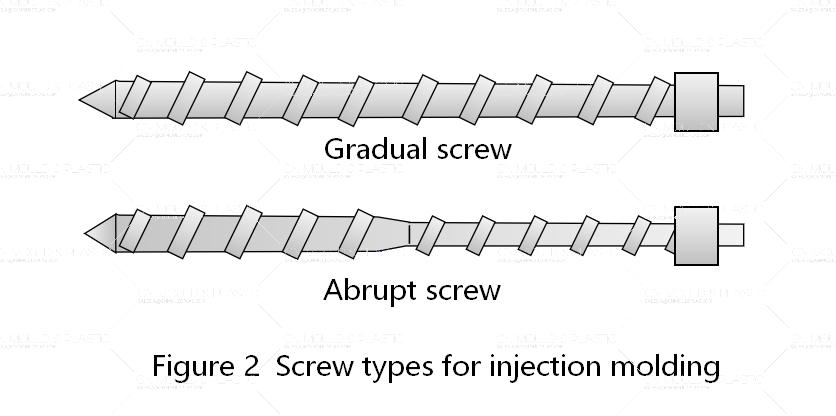
Gradual screw — the channel depth transitions slowly from deep to shallow, with a long compression section (40–50% of screw length). This provides gentle, gradual melting and is ideal for amorphous plastics like PVC, PC, and PMMA.
Abrupt screw — the transition happens over a short distance, with a compression section of only 5–15%. This delivers rapid, intense melting and is best for crystalline plastics like PP, PE, PA, and POM.
Universal screw — the compression length falls between gradual and abrupt. It offers adjustable performance through back pressure control, making it adaptable to various materials. Choose this if you frequently switch between different resins.
Screw Tip Options
Most injection machines have limited screw inventory. To expand processing flexibility without buying new screws, you can change the screw tip.
Tapered or threaded tip – Designed for high‑viscosity, heat‑sensitive materials (like PVC). It prevents material stagnation and decomposition by ensuring clean discharge during each shot.
Non‑return valve (check ring) tip – Suitable for medium‑to‑low viscosity materials. It prevents melt from flowing back through the screw channels during injection, maintaining injection pressure, shot consistency, and part quality.

 English
  français
  Deutsch
  Español
  italiano
  русский
  português
  العربية
  dansk
dansk  Suomi
Suomi  Svenska
  norsk
norsk