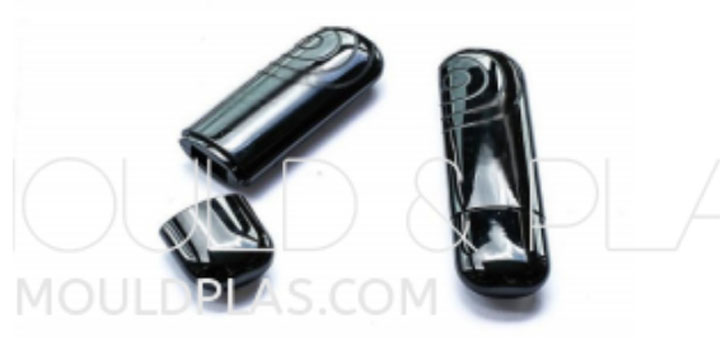
When a plastic part contains side holes, side undercuts, or protrusions that are not parallel to the mold opening direction, the corresponding mold components will obstruct part ejection after molding. Except in rare cases where forced ejection is feasible, it is generally necessary to design these components as laterally movable cores. These cores must be retracted before part ejection, then reset after mold closing. The mechanism responsible for this lateral movement is called the core-pulling mechanism. As a fundamental mechanism in injection molding, it essentially serves as a device for part release.
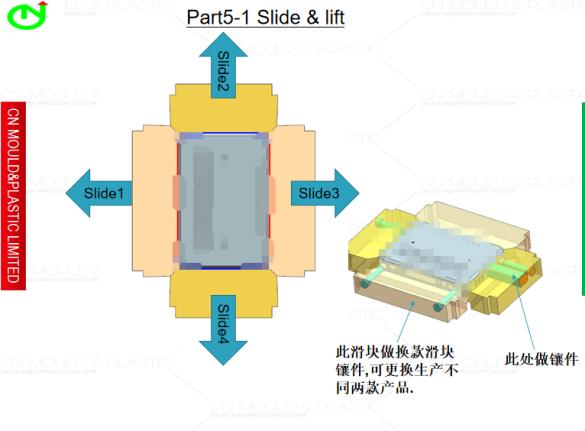
There are two operational sequences for such molds:
1. Lateral core-pulling completes before part ejection during mold opening.
2. Core-pulling occurs simultaneously with part ejection.
Classification and Characteristics of Common Core-Pulling Mechanisms
Based on structural requirements, mechanisms are categorized as internal or external core-pulling. According to power source, they are classified as:
1. Mechanical Core-Pulling
Utilizes the mold opening force to actuate lateral movement through transmission components. Advantages include:
Operational convenience
High production efficiency
Compatibility with automation
Despite complex structures, these remain widely used. Main types include:
Angled leader pin systems
Dog-leg cam mechanisms
Angular slide systems
Rack and gear systems
Spring-assisted systems
2. Hydraulic/Pneumatic Core-Pulling
Employs pressurized oil/air as power source with dedicated cylinders. Key features:
Smooth transmission
Long retraction distances
High pulling force
Flexible operation timing
These systems operate independently of mold opening/closing cycles, making them ideal for large molds. Hydraulic systems are more common than pneumatic due to standard equipment on injection molding machines.
Design Essentials
1. Ensure sufficient guiding length for moving components. Large slides require anti-wear measures.
2. Focus on reliability and rigidity of transmission components in complex mechanisms.
3. Incorporate robust locking devices to secure cores during mold clamping.
4. Implement precise positioning systems to prevent accidents during mold closing.
5. Prioritize simplified solutions that meet product requirements while minimizing structural complexity.
6. Verify machine specifications for adequate opening stroke and force when necessary.
Prevent interference between side cores and ejector pins during mold closing. When unavoidable, incorporate early-return mechanisms to protect mold components.

 English
  français
  Deutsch
  Español
  italiano
  русский
  português
  العربية
  dansk
dansk  Suomi
Suomi  Svenska
  norsk
norsk