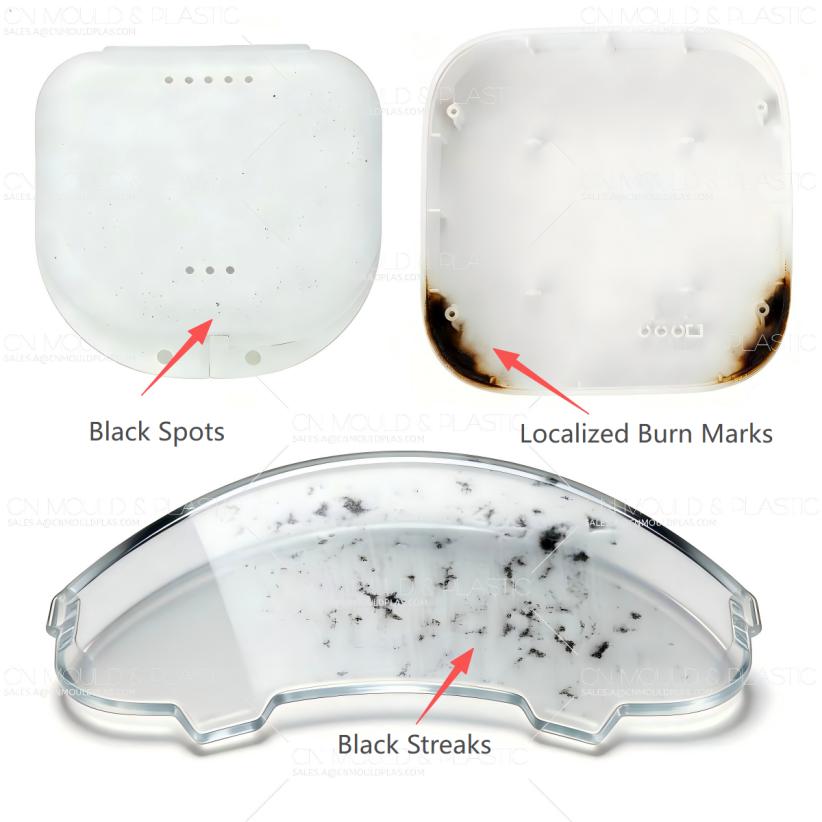
During injection molding, black spots defect are a common quality defect that directly affects product appearance and yield rate. These defects mainly include three types: black spots, localized burn marks, and black streaks.
Black Spots
Appearance: Visible impurity spots on the part surface.
Cause: Contamination in the mold or material, or degraded carbonized residue trapped in dead spots of the barrel.
Solutions:
When black spots are present only on the surface, Clean the mold and prevent dust from entering the cavity.
When black spots are present both inside and outside, Check for contaminated raw materials; remove carbonized deposits from the nozzle, flange, barrel, and screw; adjust barrel temperature and back pressure.
Localized Burn Marks
Appearance: Localized degradation of melted material caused by trapped gas overheating in the cavity.
Cause: Excessive melt temperature or compressed gas overheating in the cavity.
Solutions:
Repair the temperature control system to avoid excessive barrel temperature.
Reduce injection speed and pressure appropriately.
Clean residual resin from the barrel.
Choose the right barrel size to avoid prolonged melt residence time.
Add venting grooves and improve mold venting.
Black Streaks
Appearance: Dark patches or localized discoloration on the part surface.
Cause: Resin degradation and discoloration before injection. Possible reasons include excessive barrel temperature, too high injection speed or pressure, uncleaned residual resin, overly long cycle time, or defects in the screw/barrel.
Solutions:
Check raw materials: Remove contaminated pellets.
Adjust process parameters: Lower barrel temperature, injection pressure, injection speed, screw speed, and back pressure.
Control residence time: Avoid long melt residence time above 260°C; during machine stops, reduce temperature below 150°C.
Clean equipment: Inspect and clean carbon buildup in flow channels, screw, non-return valve, flange, and other areas.
Key Takeaway
To solve black speck defects, the key is to accurately identify the defect type and systematically investigate from three angles: raw materials, equipment, and process parameters. This enables fast diagnosis and precise correction.

 English
  français
  Deutsch
  Español
  italiano
  русский
  português
  العربية
  dansk
dansk  Suomi
Suomi  Svenska
  norsk
norsk