Why Anneal?
The purpose of annealing is to eliminate localized stress concentrations that occur in plastic parts during cooling and solidification. These stresses arise when different sections of a part cool at different rates. For example, at the junction between a thick section and a thin section, the thick area cools slowly while the thin area cools quickly. This uneven crystallization shrinkage creates internal stress concentrations.
This phenomenon is even more pronounced around metal inserts. If annealing is not performed, cracks may eventually appear in these stress‑concentrated areas, leading to part failure, cracking, or distortion.
How to Anneal
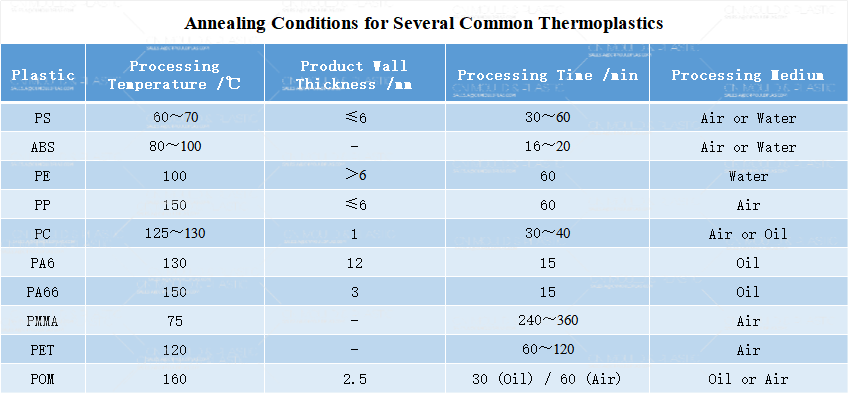
Annealing is typically carried out by immersing the part in hot oil or hot water, or by placing it in circulating hot air. The annealing temperature should be adjusted according to the type of plastic. As a general rule, the temperature is set 10–20°C below the heat deflection temperature of the material.
The temperature must not be too high, otherwise the part may deform. On the other hand, if the temperature is too low, the annealing effect will be insufficient to relieve internal stresses.
Do All Plastics Need Annealing?
Not every plastic part requires annealing. Heat treatment is generally necessary for:
Parts made of plastics with rigid molecular chains and a high glass transition temperature (Tg)
Parts with large wall thickness
Parts containing metal inserts
Parts that must operate over a wide temperature range, require tight dimensional tolerances, or have high internal stress that does not dissipate on its own
Conversely, for plastics with highly flexible molecular chains and a low glass transition temperature — such as polyoxymethylene (POM) and chlorinated polyether — internal stresses tend to relax gradually by themselves. If the service temperature requirements are not demanding, these parts may be used without annealing.

 English
  français
  Deutsch
  Español
  italiano
  русский
  português
  العربية
  dansk
dansk  Suomi
Suomi  Svenska
  norsk
norsk