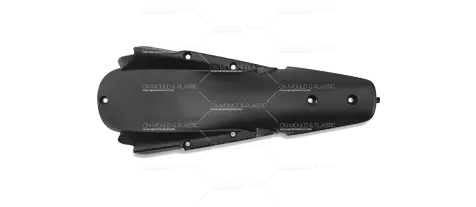
Poor surface gloss refers to a dull, matte, or unevenly shiny appearance on all or part of a plastic product, as illustrated in Figure. For transparent plastic parts, poor gloss often reduces light transmission, which can affect product performance.
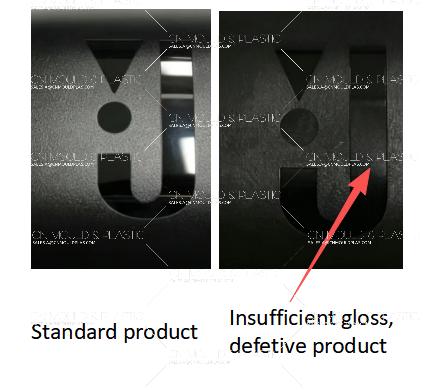
This issue can stem from three main areas: material, mold, and injection molding process.
Material
Cause | Solution |
Insufficient drying | Extend drying time |
Poor material flowability | Add flow improvers or switch to a material with better flow |
Material decomposition or discoloration | Lower processing temperature or use a heat�stable material |
Mold
Cause | Solution |
Cavity surface oxidation, wear, or insufficient polishing | Clean the surface, increase polishing requirements, or use better mold steel |
Oil, moisture, or excessive/improper mold release agent on cavity surface | Keep cavity surface clean; remove oil and moisture; use the correct type and amount of release agent (or none at all) |
Improper mold temperature (too high or too low) | Adjust mold temperature appropriately. Note: Higher temperature increases gloss on high-gloss surfaces but may dull textured surfaces |
Too little draft angle, abrupt thickness changes, oversized ribs, small or sudden gate/runner cross-sections, excessive shear causing turbulent flow | Increase draft angle, adjust gate/runner design, and smooth transitions |
Poor mold venting | Add or improve venting slots for better gas evacuation |
Injection Molding Process
Cause | Solution |
Injection speed too fast or too slow; too low injection pressure; too short holding time; insufficient holding pressure | Adjust process parameters based on part density variation |
Poor filler dispersion in fiber-reinforced plastics; exposed filler or random orientation of foil-like fillers; low barrel temperature; poor plasticization; insufficient feed | Use a screw designed for better mixing to enhance melting and plasticization |
Dark spots near gate or at cross-section changes | Lower injection speed, change gate location, enlarge gate area, or add radius transitions at cross-section changes |
Barrel temperature too high or too low | Adjust barrel temperature as needed |
Summary
Poor surface gloss can be effectively resolved by systematically addressing material, mold, and process factors. Start with proper material drying and mold surface maintenance, then fine‑tune injection parameters such as speed, pressure, temperature, and holding time. For persistent issues, consider mold design improvements like better venting, smoother transitions, and optimized gate placement.

 English
  français
  Deutsch
  Español
  italiano
  русский
  português
  العربية
  dansk
dansk  Suomi
Suomi  Svenska
  norsk
norsk