If your product contains sensitive circuit boards, fine solder joints, or precision sensors, traditional injection molding's high pressure and high temperature could crush or cook them.
Low-pressure overmolding was developed for exactly these products.
This article explains what it is, how it differs from traditional injection molding, and whether your product should use it.
What Is Low-Pressure Overmolding?
Low-pressure overmolding injects hot-melt material into a mold at very low pressure and cures it quickly. Instead of forcing plastic into a mold under high pressure, it gently wraps components with low-viscosity hot-melt adhesive.
Low-Pressure Overmolding vs. Traditional Injection Molding
Pressure: 1.5–40 bar, roughly one-tenth of traditional injection molding (350–1300 bar). This is what determines whether components survive.
Temperature: 190–230°C, compared to 230–300°C for traditional molding. For soldered PCBs and battery modules, this difference can be the line between usable and destroyed.
Material: Hot-melt adhesives (polyamide or polyolefin) flow easily under minimal pressure and provide waterproofing, environmental resistance, and electrical insulation. Traditional engineering plastics offer high strength but lower adhesion to metals and polar materials, and are mainly used for structural housings.
Low-Pressure Overmolding vs. Potting
If you already use potting, low-pressure overmolding is worth considering. It forms the housing in one step, uses less material, cures in seconds instead of up to 24 hours (typically 15–60 seconds.), and the thermoplastic adhesive can be recycled.
What Does It Protect?
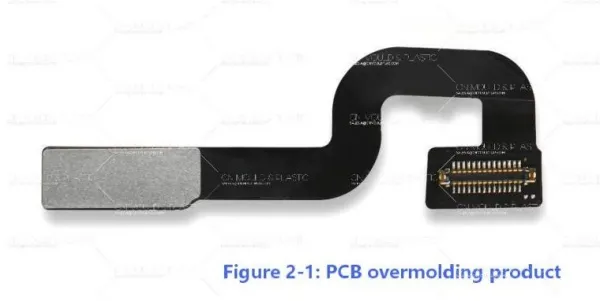
Precision, sensitive components that cannot withstand pressure or heat: PCBs, automotive sensors and ECUs, wire harnesses and waterproof connectors, pressure/temperature/current sensors, micro switches, inductors, and antennas.
Looking for a low-pressure overmolding supplier? CN MOULD has years of injection molding experience and multiple successful PCB overmolding cases. We welcome your inquiry.

 English
  français
  Deutsch
  Español
  italiano
  русский
  português
  العربية
  dansk
dansk  Suomi
Suomi  Svenska
  norsk
norsk