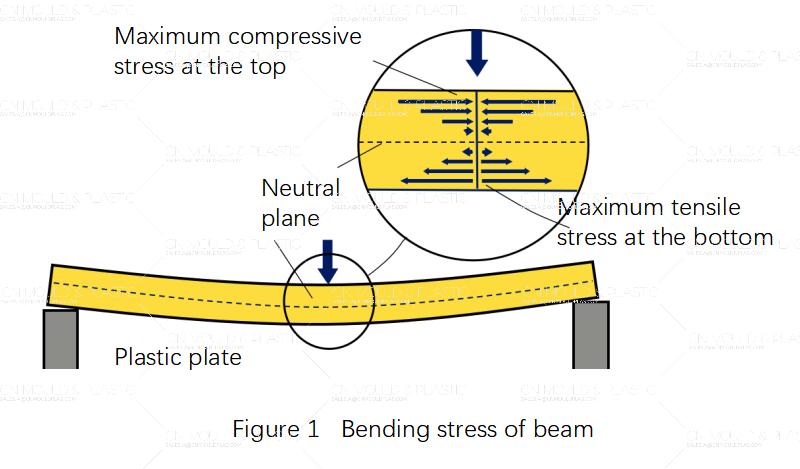
When a plastic or metal specimen with a rectangular cross‑section is bent between your fingers, one surface is stretched under tension while the opposite surface is compressed, as shown in Figure 1. Between these two surfaces lies a region of zero stress known as the neutral axis.
Assumptions of Simple Beam Bending Theory
To analyze bending behavior, simple beam bending theory is based on the following assumptions:
1) The beam is initially straight, stress‑free, and symmetric.
2) The beam material is linearly elastic, uniform, and isotropic.
3) The proportional limit is not exceeded.
4) The elastic modulus of the material is the same in tension and compression.
5) All deflections are small, so that plane cross‑sections remain plane before and after bending.
Why Flexural Testing Matters for Plastics
The flexural properties test is illustrated in Figure 2. Using these relationships, both flexural strength and flexural modulus (stiffness) can be determined through laboratory testing. In material specification sheets, the flexural modulus is typically derived from the initial slope of the load‑deflection curve.
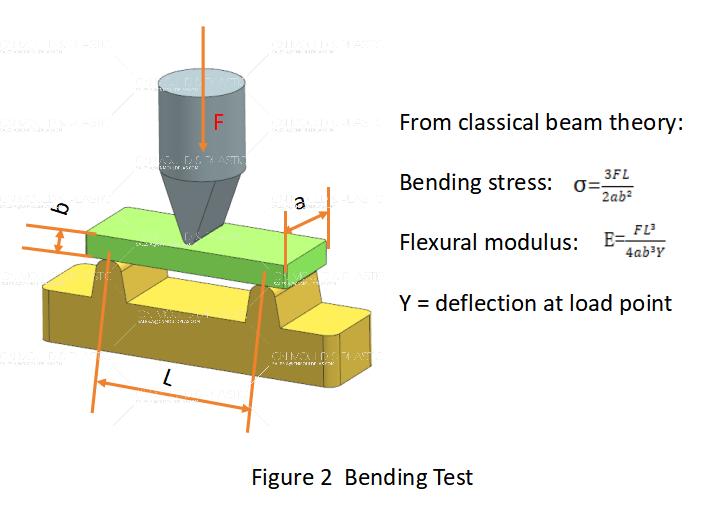
For most plastic parts, bending is a common mode of loading in actual use. Therefore, flexural properties often provide more accurate and relevant results for part design and material selection than their corresponding tensile properties.

 English
  français
  Deutsch
  Español
  italiano
  русский
  português
  العربية
  dansk
dansk  Suomi
Suomi  Svenska
  norsk
norsk