Hardness is a measure of a solid material's ability to resist permanent deformation when subjected to a compressive force. Hardness varies significantly between different materials — metals, for example, are generally much harder than plastics.
Hardness is typically associated with strong intermolecular bonds, but the macroscopic behavior of solid materials under force is complex. In practical applications, harder plastics tend to offer better resistance to scratching or wear. For this reason, hardness is a fundamental property of plastics, especially for materials that must also be tough.
It is worth noting that hardness has a positive correlation with yield strength and tensile strength. This means that an increase in hardness is often accompanied by an overall increase in material strength.
Two Main Methods for Measuring Plastic Hardness
Two widely used methods for measuring the hardness of plastics are the Shore (Durometer) hardness test and the Rockwell hardness test. The choice of method depends on the material being tested.
Material Type | Recommended Method | Examples |
Softer materials | Shore hardness | Elastomers, rubber, PP, PE, PVC |
Harder materials | Rockwell hardness | PC, PS, PA (nylon) |
1. Shore (Durometer) Hardness
The Shore hardness test is primarily used for softer plastics and elastomers. It measures the resistance of a material to indentation using a spring‑loaded indenter. The hardness value is read directly from a scale ranging from 0 to 100, where a higher value indicates a harder material.
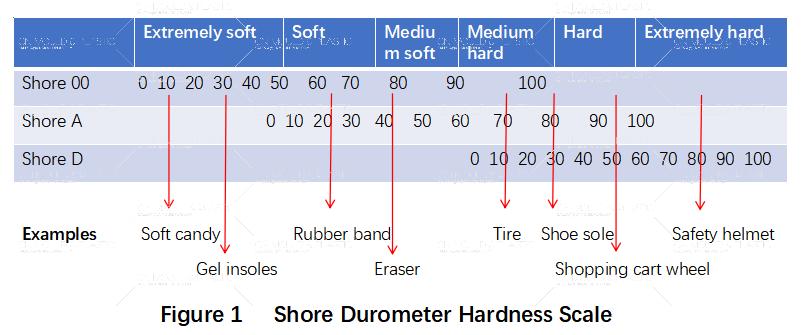
Different Shore scales are used for different material types. Shore 00 is used for measuring lightweight foams, sponge rubber, and soft gels. Shore A is used for rubber, soft plastics, and rubber‑like elastomers. Shore D is used for hard rubber, rigid plastics, and thermoplastics. Figure 1 illustrates the typical hardness ranges for these scales.
2. Rockwell Hardness
The Rockwell hardness test measures the permanent indentation resistance of a material. This is achieved by applying a specific load through a ball indenter. The depth of the indentation is measured and used to calculate the surface area of the indentation, from which the hardness value is derived.
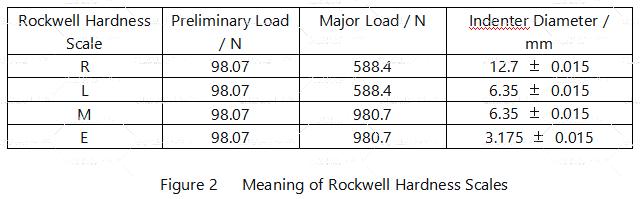
The diameter of the ball indenter varies depending on the specific test method. Rockwell hardness uses a variety of scales, each with a different ball size and applied load. These scales are designated by letters. For softer materials such as plastics and rubber, the most common Rockwell hardness scales are E, M, L, and R.
The meaning of each Rockwell hardness scale is shown in figure 2.

 English
  français
  Deutsch
  Español
  italiano
  русский
  português
  العربية
  dansk
dansk  Suomi
Suomi  Svenska
  norsk
norsk