In the mold manufacturing industry, trial molding and acceptance are essential steps to verify the stability, reliability, surface quality, and production efficiency of an injection mold. Today, we will discuss two key questions: What should you prepare before a mold trial? And how should you handle issues discovered after the trial?
Pre‑Trial Preparations
1. Understand the Mold Structure and Product Requirements
Before the trial, review the general assembly drawing of the mold. Understand the basic structure, opening sequence, ejection method, and any special points requiring attention.
2. Familiarize Yourself with Product Information
Know the plastic material grade, total part weight, runner weight, and product quality requirements.
3. Issue a Trial Molding Notification
Arrange the trial in advance by issuing a formal notification to inform all relevant personnel and ensure they are ready.
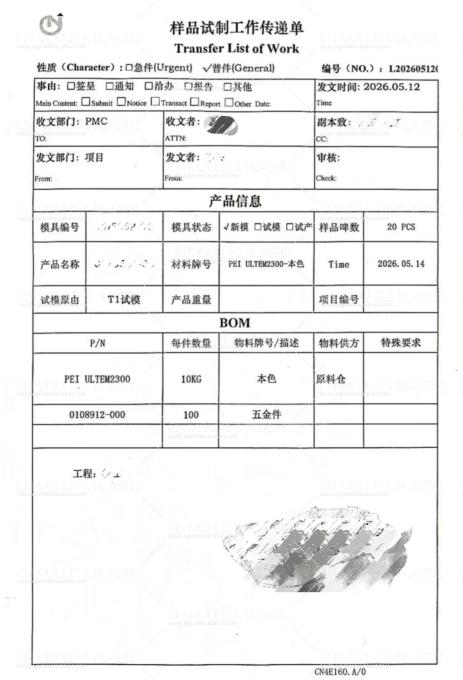
4. Prepare Materials and Equipment
Prepare the required plastic material (collect and dry it beforehand)
If inserts are needed, preheat them
Preheat the injection molding machine and clean the barrel
Prepare the trial molding process card
5. Write an Injection Molding Process Card
Prepare an injection molding process parameter card for the product in advance. This card will serve as the reference during the trial.
6. Select the Right Injection Molding Machine
Choose a machine that matches the mold specifications. Key parameters to verify include injection volume, clamping force, projected part area, distance between tie bars, and ejection stroke. Ensure all of these are compatible with the mold design.
Post‑Trial Troubleshooting and Rework
1. Issue a Rework Notification
Any problems found during the trial must be formally recorded using a rework notification.
2. Analyze the Problem and Provide Clear Conclusions
Attach diagrams to the rework notice and clearly describe all modifications needed. Consolidate all issues into a single request whenever possible. Try to complete all rework in one round to avoid repeated mold trials and multiple rework cycles.
Mold designers must fully understand the causes of common molding defects and their solutions. Carefully determine whether the problem stems from mold design, manufacturing quality, or injection molding parameters. Only then should a modification plan be made.
3. Submit Samples on Time
Complete trial molding according to the agreed timeline (T0 / T1 / T2 / T3) and deliver plastic samples to the customer promptly.
4. Ensure Quality Control
Project management and the quality department must work closely together. Any mold with quality issues shall not be accepted into inventory.
Final Takeaway
A successful mold trial does not happen by chance. It requires thorough preparation, clear documentation, careful problem analysis, and strict quality control. By following these steps — from pre‑trial planning to post‑trial rework — you can ensure stable, reliable, and efficient mold production.

 English
  français
  Deutsch
  Español
  italiano
  русский
  português
  العربية
  dansk
dansk  Suomi
Suomi  Svenska
  norsk
norsk