Tensile testing is a fundamental method for evaluating the mechanical properties of plastic materials. It measures both tensile strength and elongation at break by applying a controlled tensile load along the longitudinal axis of a test specimen until failure occurs. The test is performed under specified conditions of temperature, humidity, and pulling speed.
Key Metrics: Tensile Strength and Elongation at Break
Tensile strength is the maximum tensile stress a material can withstand before breaking. It is calculated based on the original cross‑sectional area of the specimen and is expressed in megapascals (MPa) .
Elongation at break is the percentage increase in the distance between two gauge length on the specimen at the moment of fracture, compared to the original gauge length. It reflects the material's ductility. The elongation at break is calculated using the following formula:
ε = (L – L₀) / L₀ × 100%
Where:
ε = Elongation at break (%)
L₀ = Original gauge length (cm)
L = Gauge length at break (cm)
Applicable Standards
Tensile testing of plastics should follow established standards to ensure repeatable and comparable results. Relevant standards include:
GB 2918-2018 – Standard atmosphere for conditioning and testing of plastic specimens
GB/T 1040.1-2025 – Test method for tensile properties of plastics
Relevant injection‑molded product standards
Specimen Shape Selection
The shape of the test specimen depends on the material type:
Rigid or semi‑rigid thermoplastics → Double‑shovel (Type I) specimen
Soft thermoplastics → Dumbbell‑shaped (Type II) specimen
Thermosets → Figure‑eight (Type III) specimen
Choosing the correct specimen shape ensures that the test results accurately reflect the material's true tensile behavior.
Tensile Speed Selection
Tensile speed (crosshead speed) is an important parameter that affects test results. The table below shows the recommended speed ranges for different material types.
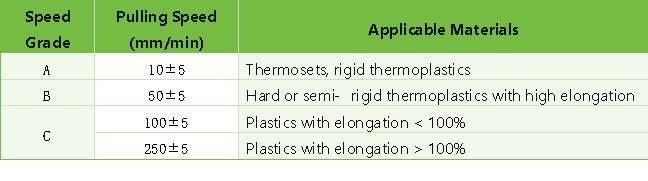
The appropriate speed should be selected based on the material's expected elongation behavior.

 English
  français
  Deutsch
  Español
  italiano
  русский
  português
  العربية
  dansk
dansk  Suomi
Suomi  Svenska
  norsk
norsk