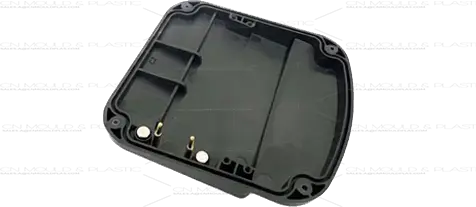
We recently ran a trial molding for a plastic part. Every shot had tearing at the bottom — same spot every time.
Without fixing it, the samples wouldn‘t pass. We couldn't deliver to the customer.
Our engineers checked three things.
Ejection system. Ejector pins, plate, speed — all normal.
Draft angle. Measured against the drawing — within spec.
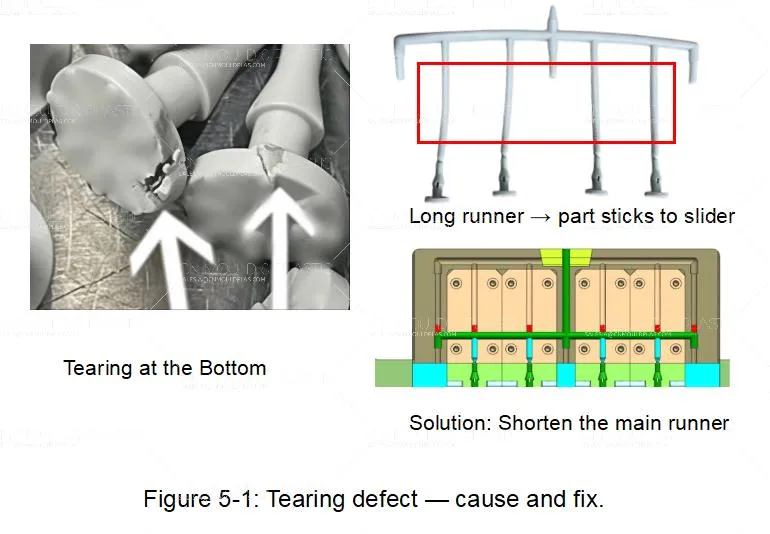
Slider. The bottom of the part is formed by a slider. During ejection, the slider pulls away first, then the part is ejected. But part of the product stuck to the slider and got dragged. By the time ejection happened, that area had torn.
Why It Happened
Why did it stick? The main runner was too long. A long runner means lower pressure at the end of fill. The bottom area wasn‘t packed densely enough. After cooling, shrinkage was uneven — and part of the product gripped the slider tightly. When the slider pulled away, it tore the part.
How We Solved It
Since the root cause was the runner length, we shortened it.
We redesigned the main runner to reduce the flow distance. With a shorter runner, the pressure at the end of fill was higher. The bottom area packed more densely. Cooling shrinkage became more uniform. The part no longer gripped the slider.
The Result
On the second trial, the tearing was gone. The part ejected cleanly, with the bottom intact.
From first trial to second trial — less than a week. Samples sent to customer, approved, and the project moved into mass production.

 English
  français
  Deutsch
  Español
  italiano
  русский
  português
  العربية
  dansk
dansk  Suomi
Suomi  Svenska
  norsk
norsk