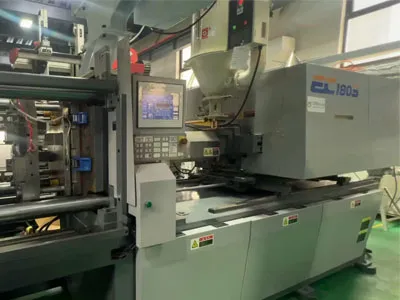
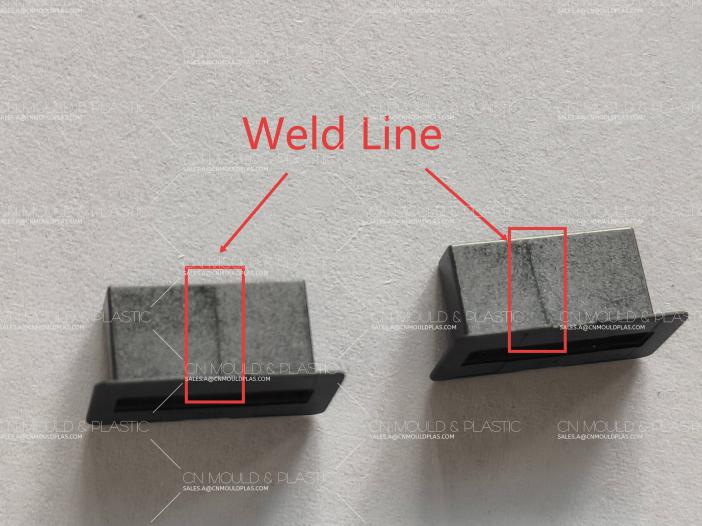
Weld lines form where two melt fronts meet inside the mold cavity. Long flow paths cause the melt to cool, and trapped air prevents proper fusion, resulting in weak, visible lines. This article outlines key mold design and process guidelines to minimize or eliminate weld lines.
1. Mold Design Guidelines
① Optimize runner and gate layout
Design the feed system so that the resulting melt‑fill pattern either avoids weld lines entirely or positions them where they will not affect appearance or mechanical strength.
② Provide effective venting
Venting releases trapped air from the cavity before it can be compressed. Reduce the depth of V‑notches to minimize crack risk. Use vented ejector pins or split inserts near weld‑line areas, or consider a vacuum system to remove all air from the cavity prior to filling.
③ Keep runners as short as possible
Shorter flow paths help maintain melt temperature at the weld line, giving polymer chains more energy for diffusion and entanglement. They also improve packing efficiency from the nozzle to the weld line, pulling more material toward the mold surface to make V‑notches shallower and less sharp. Hot runner systems offer an advantage here, as they eliminate the pressure drop and temperature loss associated with conventional cold runners.
④ Use large runner and gate cross‑sections
Larger cross‑sections improve packing effectiveness at the weld line, providing the positive benefits described above.
⑤ Maximize draft angles and balanced ejection area
Generous draft and balanced demolding surfaces allow stronger packing pressure at the weld line without increasing part stress. This may also reduce or eliminate the need for mold release agents.
2. Process Conditions
① Increase melt temperature
Higher melt temperatures provide more energy for polymer chains to diffuse and entangle across the weld interface.
② Increase mold temperature
Higher mold temperatures slow down cooling, allowing more time for polymer chain diffusion and entanglement before solidification.
③ Increase holding (packing) pressure and time
Stronger packing pushes the two melt fronts closer together, promoting chain entanglement and forcing material outward into the V‑notch, making it shallower and less sharp.
④ Understand local flow effects
When packing pressure reaches the weld line, unbalanced pressures from opposite directions may create slow local flow in the center of the part thickness. This flow is purely shear‑driven — not fountain flow. It aligns polymer chains and glass fibers parallel to the part surface across the weld boundary, which improves chain diffusion and entanglement and helps prevent crack propagation through the part thickness.

 English
  français
  Deutsch
  Español
  italiano
  русский
  português
  العربية
  dansk
dansk  Suomi
Suomi  Svenska
  norsk
norsk