Injection pressure is the force that pushes molten plastic through the nozzle, runners, and cavity. It overcomes flow resistance and also compacts the melt to compensate for shrinkage. The pressure value directly affects melt flow and final part quality. Both too high and too low pressures are detrimental. The general rule is to select the lowest pressure that still ensures good part quality.
The appropriate injection pressure depends on several factors: material properties, nozzle and mold design, part geometry, and dimensional tolerances.
1. Material Fluidity
Good flow materials (e.g., LDPE, PA) with low precision requirements → injection pressure ≤ 70–80 MPa.
Medium viscosity materials (e.g., modified PS, PC) with moderate complexity and some precision requirements → 100–140 MPa.
High viscosity engineering plastics (e.g., polysulfone, PPO) as well as thin‑wall, long‑flow, or non‑uniform thickness parts with tight tolerances → 140–170 MPa.
Precision or micro parts → 230–250 MPa.
2. Injection Machine Type
3. Mold Design
Long flow paths, narrow cavities or runners, small gates, or a large number of gates increase flow resistance → use higher injection pressure.
4. Part Geometry
Large, complex, thin‑walled, or long‑flow parts need higher injection pressure.
5. Nozzle Type
Open (straight‑through) nozzles – large bore, low resistance → lower pressure is acceptable.
Shut‑off (spring‑loaded) nozzles – melt must overcome spring force and open a valve, which consumes energy and reduces pressure → higher injection pressure is required.
6. Processing Conditions
Melt temperature and mold temperature interact with injection pressure. Higher melt or mold temperature improves flowability and allows lower injection pressure. Lower temperatures require higher pressure.
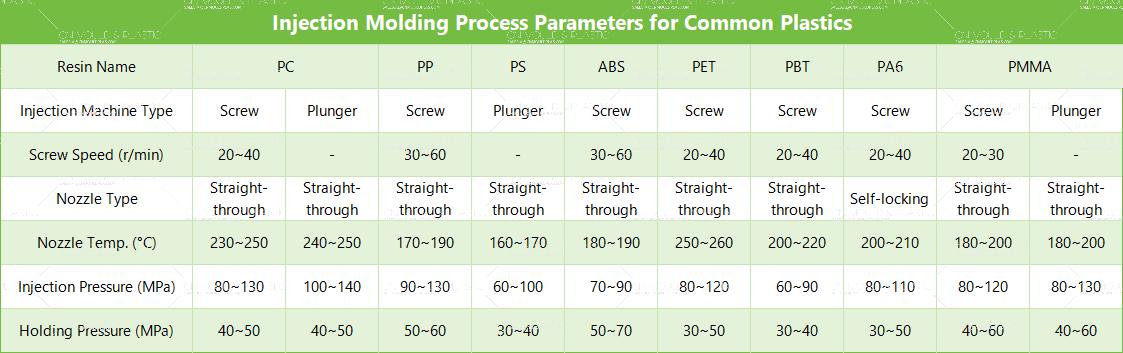
Effects of Incorrect Injection Pressure
A. Pressure Too Low
The melt must overcome high friction and viscous resistance, so pressure loss reduces the actual filling pressure, especially for long flow paths or complex shapes.
Difficult filling leads to rough surfaces or short shots (incomplete parts).
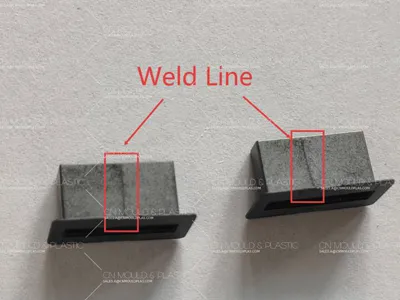
During filling, low pressure produces a slow, spreading flow, extending cycle time and often causing weld lines or density variations.
B. Pressure Too High
Melt speed increases dramatically. When passing through a small gate, jetting may occur, trapping air and creating bubbles, silver streaks, or burns due to compressed air heating.
Excessive pressure can over‑pack the cavity, causing flash, high internal stress, and ejection difficulties. Sticking parts may warp or deform during ejection.

 English
  français
  Deutsch
  Español
  italiano
  русский
  português
  العربية
  dansk
dansk  Suomi
Suomi  Svenska
  norsk
norsk