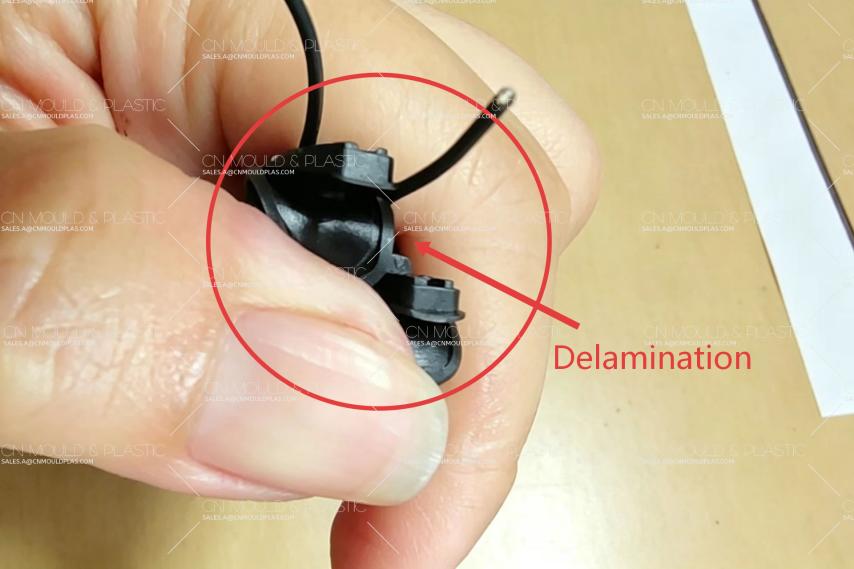
Surface peeling ( Delamination) is a common defect in injection molded parts, where thin layers separate from the surface. Understanding the root causes is essential for producing high‑quality parts.
1. Causes of Surface Peeling
Peeling occurs when the material fails to bond properly during molding. The main causes include:
Poor compatibility of resin blends – When different types of resins are mixed unintentionally (e.g., incomplete purging during material changeovers, or contamination of regrind with foreign plastics), the lack of compatibility between them leads to poor fusion and surface delamination.
Excessive lubricant or mold release agent – Too much lubricant or release agent can interfere with melt bonding, causing weak interfaces that separate easily.
Low melt temperature – When the material temperature is too low, the flowing melt can form boundary layers that do not fully fuse, resulting in peeling.
Excessive injection pressure – Overly high injection pressure can cause the part to stick to the mold, making ejection difficult and potentially damaging the surface layers.
2. Preventive Measures
To avoid surface peeling, follow these recommendations:
Use a compatibilizer for blended materials – If you must use a resin blend, add an appropriate compatibilizer to improve compatibility between the different polymers.
Keep materials pure – Avoid mixing different resin types. Ensure that regrind or recycled material is free from contamination and matches the virgin resin.
Minimize lubricant and release agent usage – Use only the necessary amount; reducing these additives improves melt fusion and layer bonding.
Increase melt or mold temperature – Raising the barrel temperature or mold temperature improves melt flow and helps layers fuse completely.
Reduce injection pressure – Lowering the injection pressure prevents sticking and makes demolding easier. For PVC materials, also reduce the injection speed.

 English
  français
  Deutsch
  Español
  italiano
  русский
  português
  العربية
  dansk
dansk  Suomi
Suomi  Svenska
  norsk
norsk