During injection molding, plastic parts may sometimes show unwanted color changes — such as yellowing, browning, or dark streaks. This defect is often referred to as discoloration. Understanding the causes is the first step to preventing it.
1. Main Causes of Discoloration
① Unstable colorants or additives
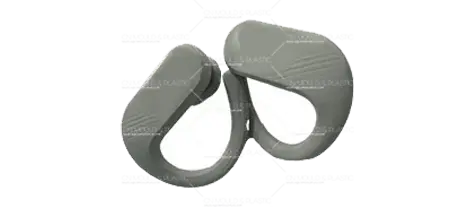
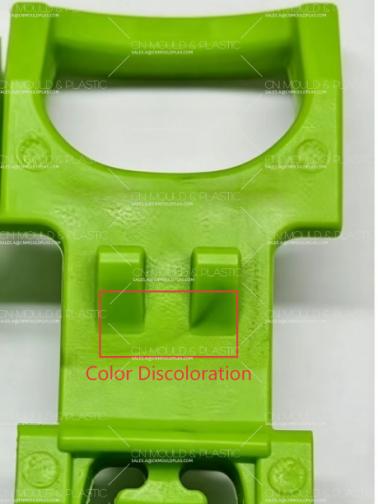
Some colorants or additives do not have sufficient thermal stability. They break down easily when exposed to high temperatures inside the barrel, causing discoloration, as shown in the image below. This problem is more likely to occur in areas with high shear flow, such as weld lines or rib structures.
② Thermal degradation of the resin
When the barrel temperature is too high, the molten plastic may overheat and decompose. High temperature at the nozzle can also cause material to stagnate and burn, leading to surface discoloration on the molded part.
③ Excessive injection speed
If the injection speed is too fast, the air inside the cavity cannot escape in time. The trapped air is compressed and heats up rapidly, which can cause the material to overheat and decompose. In addition, high‑speed injection creates strong shear heat as the melt passes through the runner and gate, further raising the melt temperature and potentially causing thermal degradation and discoloration.
2. How to Prevent Discoloration
① Choose stable colorants and additives
Select colorants and additives with good thermal stability that can withstand the processing temperatures of the base resin.
② Lower barrel or nozzle temperature
If discoloration occurs throughout the entire part, the molding temperature is likely too high. Reduce the barrel temperature or nozzle temperature to stay within the recommended range for the material.
③ Reduce injection speed and ensure proper venting
Discoloration caused by high injection speed and poor venting typically appears at the end of the flow path. Lowering the injection speed allows trapped air to escape more easily. Also, make sure the mold has adequate venting to prevent air compression and overheating.

 English
  français
  Deutsch
  Español
  italiano
  русский
  português
  العربية
  dansk
dansk  Suomi
Suomi  Svenska
  norsk
norsk