What Is Molding Shrinkage?
Molding shrinkage is the ratio of dimensional change caused by cooling after injection molding to the original cavity size. In simple terms, it tells you how much a plastic part shrinks after it comes out of the mold.
Shrinkage is influenced by three main factors:
Resin properties (inherent shrinkage)
Part shape
Molding conditions (heat, pressure, cooling)
To better control shrinkage, consider the following five areas.
1. Injection Process Adjustments
Keep mold temperature stable.
Avoid excessively high melt temperature.
Increase injection pressure appropriately.
Increase injection speed.
Extend holding (packing) time.
Extend cooling time appropriately.
Control mold cooling rate.
2. Material Selection
Use uniform material particle size for even heating and cooling.
Choose materials with appropriate molecular weight, narrow distribution, and suitable melt flow index. This makes process control easier and reduces shrinkage.
For crystalline plastics, use conditions that reduce and stabilize crystallinity. For amorphous plastics, minimize orientation during filling.
Use low‑moisture materials or dry thoroughly before molding.
Use filled or reinforced materials — they generally shrink less.
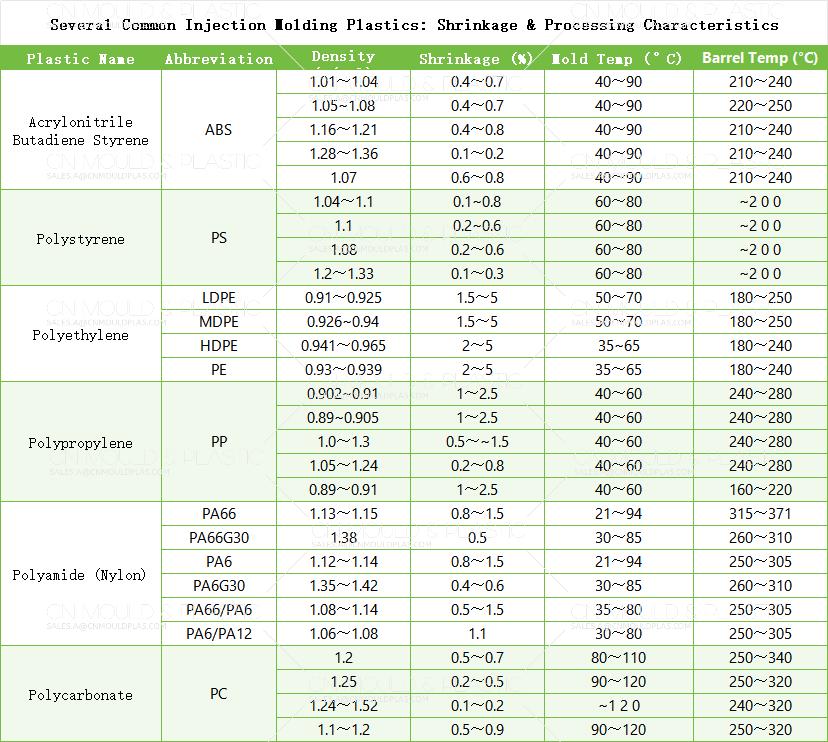
Refer to the table above to compare shrinkage rates of different materials.
3. Mold Design
Design cavity dimensions and tolerances accurately. Choose mold materials with low thermal expansion.
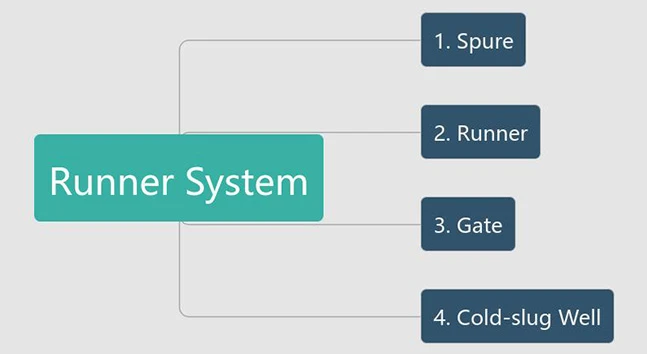
Enlarge gate cross‑section where possible.
Shorten runner length to reduce flow resistance and improve packing.
Control mold temperature precisely.
4. Injection Machine Selection
Make sure the required injection volume and projected area do not exceed 80% of the machine’s rated capacity. This ensures stable and repeatable processing.
5. Part Design Review
Review the following design features carefully, as they all affect shrinkage: wall thickness, draft angle, dimensional accuracy and tolerances, ribs, support surfaces and fillets, as well as surface finish and overall geometry.

 English
  français
  Deutsch
  Español
  italiano
  русский
  português
  العربية
  dansk
dansk  Suomi
Suomi  Svenska
  norsk
norsk