Dimensional accuracy is a critical quality for plastic parts, but it is influenced by many complex factors. Understanding these factors is essential for setting realistic tolerances and producing consistent, high-quality parts.
Below are the several main factors that affect the dimensional accuracy of injection molded parts.
1. Mold-Related Factors
The type and quality of the mold have a direct impact on part accuracy.
Mold Type & Number of Cavities: Single-cavity molds produce higher precision than multi-cavity molds. Each additional cavity reduces part accuracy by approximately 5%.
Mold Wear: Dimensional errors caused by cavity and core wear (including rework and polishing) account for about 1/6 of the total part tolerance.
Moving Components: Dimensions formed by moving mold components (such as slide cores or unscrewing devices) generally have lower precision.
System Design: Improper design of the runner/gating system or cooling system can lead to uneven shrinkage. Improper ejection system forces can deform the part during ejection.
Manufacturing tolerance of the mold itself is typically about 1/3 of the specified part tolerance. This is considered the standard level. For precision molds, the tolerance is about half of the standard level. For rough or low‑precision molds, the tolerance is about twice the standard level.
2. Material-Related Factors
The properties of the plastic material — especially its rigidity and shrinkage — significantly affect dimensional accuracy.
Shrinkage is the most fundamental factor affecting dimensional accuracy.
Low‑shrinkage materials (such as polysulfone, ABS, polystyrene, and polycarbonate) are less sensitive to process fluctuations and can achieve high dimensional accuracy.
High‑shrinkage materials (such as soft PVC and low‑density polyethylene) show wide variation in shrinkage, making it difficult to maintain tight tolerances.
Medium‑shrinkage materials (such as PP and nylon 1010) offer medium dimensional accuracy.
Filled materials (with glass fiber or other fillers) shrink less and therefore yield higher precision.
3. Design-Related Factors
The geometric design of the part itself has a direct impact on dimensional accuracy.
Parts with a well-designed geometry — uniform wall thickness, smooth transitions, and proper rib placement — experience less shrinkage and warpage, resulting in higher dimensional accuracy.
Poor design leads to uneven stress distribution and greater dimensional variation.
4. Process-Related Factors
Molding conditions directly affect how the plastic fills, packs, cools, and solidifies. As shown in the figure, key variables include:
Temperatures: mold temperature, feeding zone temperature, barrel temperature.
Pressures: packing pressure, transfer pressure, injection pressure.
Times: holding time, injection time, cooling time.
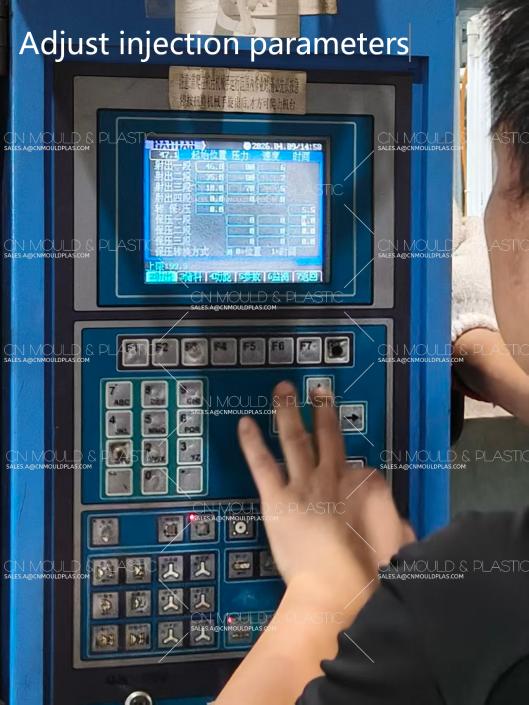
In addition, during molding, factors such as filler orientation, molecular orientation, and crystallization distribution all influence the final dimensions of the part.
Fluctuations in shrinkage caused by changing process conditions are a direct source of dimensional error — and they are the second most important factor, ranking just behind the machining precision of the mold itself.
5. Environmental Factors
Even after molding, plastic parts can change dimensionally depending on how they are stored or used. Storage and usage conditions such as temperature and humidity can cause parts to warp, swell, or shrink over time. These post-molding changes are closely related to the plastic’s inherent properties and the environmental conditions it is exposed to.

 English
  français
  Deutsch
  Español
  italiano
  русский
  português
  العربية
  dansk
dansk  Suomi
Suomi  Svenska
  norsk
norsk