What Causes Deformation in Plastic Parts?
Deformation in molded plastic parts — including warpage, cracking, bending, and twisting — is primarily caused by residual internal stresses. These stresses arise during or after the molding process for several reasons.
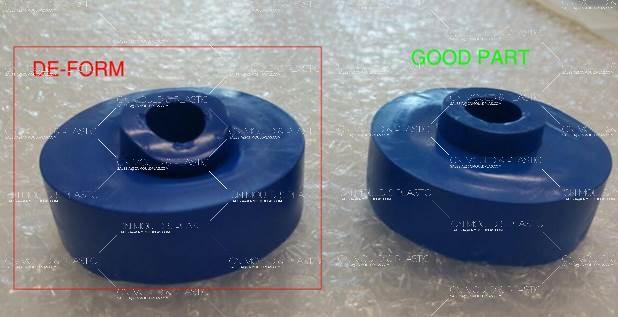
1. Uneven shrinkage due to non‑uniform wall thickness
When different sections of a part have varying thicknesses, they cool and shrink at different rates. This uneven shrinkage creates residual stresses, which are the root cause of most deformations.
2. Overpacking (excessive filling)
Forcing too much molten plastic into a fixed cavity volume generates additional residual stresses.
3. Uneven ejection forces
During demolding, if the ejection force is not balanced across the part — or if the part sticks to certain mold surfaces — residual stresses can develop, often leading to cracks around ejector pins.
4. Thermal expansion mismatch between resin and inserts
If the part contains metal inserts, the difference in coefficient of thermal expansion between the resin and the metal creates residual stress around the insert, which can lead to cracking.
5. Poor part design – for example, sharp corners
Sharp corners act as stress concentrators. Without proper fillets (rounded corners), residual stresses accumulate at these points, increasing the risk of cracking.
How to Reduce Residual Stress — Especially Near the Gate
The following measures help minimize residual stress and the resulting deformation, particularly in the gate area where stresses are highest.
Resin type: Amorphous resins generally create more residual stress than crystalline resins and are more prone to cracking. When possible, use a hot runner system with pin-point gates.
Gate type: The direct gate (sprue gate) has the lowest pressure loss but generates the highest residual stress. Instead, choose pin-point gates, side gates, or tab gates, which shift stress away from critical areas.
Injection pressure: High injection pressure directly increases residual stress. Reducing injection pressure is the easiest and most immediately effective measure you can take.
Melt temperature: Use higher melt temperatures. Hotter resin flows more easily, allowing full cavity filling even at lower injection pressures.
Mold temperature: Cold molds increase residual stress. Higher mold temperatures reduce internal stress and improve part flatness, but excessively high temperatures may cause demolding issues for certain materials.
Holding time: Longer packing time increases residual stress, so keep holding time as short as possible. Injection machines with two-stage pressure control (boost pressure + holding pressure) produce less residual stress than single-pressure machines.

 English
  français
  Deutsch
  Español
  italiano
  русский
  português
  العربية
  dansk
dansk  Suomi
Suomi  Svenska
  norsk
norsk