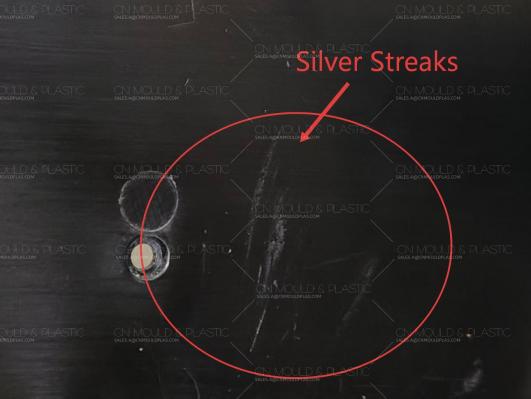
Silver streaks (also known as silver marks or mica marks) are spray‑like blemishes that appear on the surface of molded parts, radiating outward from the gate in a fan‑shaped pattern, as shown in the Figure. These defects are typically caused by trapped air, moisture vaporization, or decomposition of incompatible foreign materials.
Causes
Plastics tend to absorb moisture during storage. If the material is not properly dried before molding, the residual moisture turns into steam during processing, creating spray‑like marks on the part surface.
During plasticization, the melt can entrap small amounts of air. If this air cannot escape during the injection stage, it leaves silver streaks on the surface.
Degraded or burnt plastic particles — often resulting from thermal decomposition — can also leave silver streaks on the finished part.
Practical measures to prevent and eliminate silver streaks
1. Injection Molding Machine and Mold
When switching between different material types, thoroughly purge the barrel to avoid cross‑contamination.
If the nozzle has obstructions or burrs that restrict melt flow, repair or replace it. If melt drooling or stringing occurs at the nozzle tip, clean the nozzle.
If the gate is too small or the runner too narrow, enlarge them to improve flow.
If mold venting is inadequate, modify the venting slots or holes to prevent air entrapment caused by unbalanced flow.
If the cavity surface has high roughness, polish the mold to improve surface quality.
2. Raw Materials
If the material contains excessive moisture or volatiles, dry it thoroughly before processing.
If the material is contaminated, replace it with clean resin.
If certain additives (such as lubricants or antistatic agents) are overdosed, reduce their content appropriately.
3. Processing Conditions
Lower injection pressure and reduce injection speed.
Increase mold temperature.
Reduce barrel temperature to lower the melt temperature.

 English
  français
  Deutsch
  Español
  italiano
  русский
  português
  العربية
  dansk
dansk  Suomi
Suomi  Svenska
  norsk
norsk